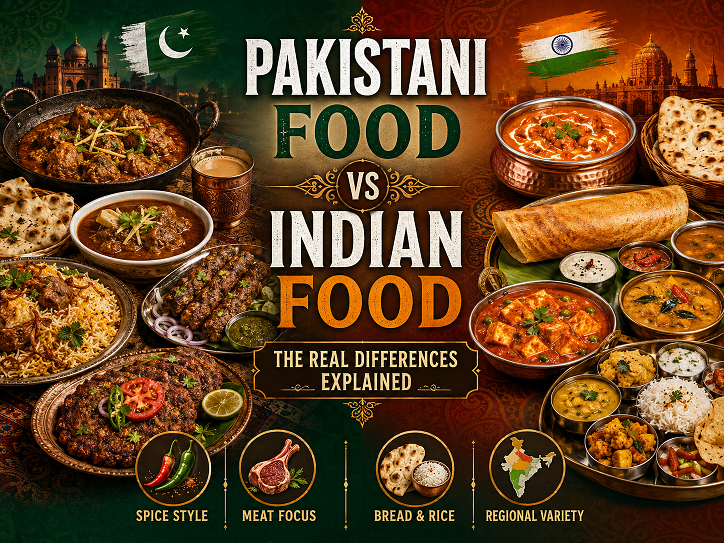
Pakistani and Indian food share a lot — history, many dishes, overlapping spices — especially because Punjab, one of the most food-influential regions, was split between both countries in 1947. But they’re not the same cuisine. Pakistani food tends to be more meat-centric overall and draws heavily on Punjabi, Sindhi, Pashtun, and Balochi traditions. Indian food spans a much wider range — including major vegetarian culinary traditions in the south and west that simply don’t have a Pakistani equivalent. The confusion mostly comes from abroad, where restaurants often market both as “Indian food” regardless of who’s actually cooking or what region the menu represents.
A Question That Comes Up a Lot
If you’ve ever mentioned Pakistani food to an American friend, there’s a decent chance you’ve heard something like “oh, so it’s basically Indian food?” It’s an understandable assumption — and not entirely wrong — but it also misses a lot.
The truth is more interesting than “same” or “completely different.” Pakistani and Indian cuisines are like two trees that share a large section of trunk but branch off in genuinely different directions. Understanding where they overlap — and where they don’t — says a lot about the history, geography, and cultures of both countries.
Why They Overlap So Much — A Shared History
Until 1947, Pakistan and India were part of the same country under British colonial rule. The province of Punjab — one of the most agriculturally rich and food-influential regions in all of South Asia — was split roughly in half between the two new countries during Partition.
This single fact explains a huge amount of the overlap. Punjabi cuisine — known for its tandoor-cooked breads, rich curries, and dairy-heavy dishes — exists on both sides of the border, just adapted slightly differently over the following decades. Many of the dishes people associate most strongly with “Indian food” abroad — butter chicken, various kebabs, naan, certain styles of biryani — actually have Punjabi roots that are just as much Pakistani as Indian.
So when people say Pakistani and Indian food are “the same,” what they’re often actually noticing is that Punjabi food is hugely influential in both countries — which is true. The mistake is extending that to mean *all* Pakistani food and *all* Indian food are the same, when each country also has huge culinary traditions well beyond Punjab.
The Real Differences — Region by Region
Pakistan’s Culinary Map Is Smaller, But Distinct
Pakistani cuisine draws primarily from four major regional traditions: Punjabi (the most dominant, especially in everyday home cooking), Sindhi (known for distinct spice blends and seafood in coastal areas), Pashtun/Pukhtun (heavier on grilled meats, simpler preparations, influenced by Central Asian cooking), and Balochi (known for very simply prepared meat dishes, often slow-cooked).
Across all of these, one pattern holds fairly consistently: meat — chicken, beef, mutton — plays a central role in everyday cooking. Vegetarian dishes exist and are eaten, but they’re generally not the centerpiece of a typical home-cooked meal the way they can be in many parts of India.
India’s Culinary Map Is Vastly Larger
India spans a far greater geographic and cultural range — from Punjab and Rajasthan in the north, to Gujarat and Maharashtra in the west, to Tamil Nadu, Kerala, and Andhra Pradesh in the south, to Bengal in the east, each with cuisines that can differ as much from each other as they do from Pakistani food.
Crucially, several of these regions — particularly in the south and west — have major vegetarian culinary traditions, often tied to religious and cultural practices, that produce entire categories of dishes (dosas, idlis, a vast range of lentil and vegetable preparations) with no real equivalent in typical Pakistani home cooking.
The Simplest Way to Think About It
Comparing “Pakistani food” to “Indian food” as single categories is a bit like comparing “Mexican food” to “food from all of Latin America.” There’s real overlap and shared history at the edges, but one is a specific (if internally diverse) national cuisine, and the other spans a much wider range that includes — but isn’t limited to — cuisines similar to the first.
Dishes — Shared, Pakistani-Leaning, and Indian-Leaning
Found in Both, Often Nearly Identical
Various biryanis, seekh kebabs, naan and other tandoor breads, butter chicken-style curries, and many lentil (daal) preparations exist on both sides of the border with only minor regional variation — a direct legacy of shared Punjabi culinary tradition.
Pakistani-Leaning Dishes
Dishes like nihari (a slow-cooked stew, often eaten for breakfast), karahi (a quick-cooked meat dish in a wok-like pan), Sindhi biryani’s specific spice profile, and Peshawari-style grilled meats reflect cooking styles more strongly associated with Pakistani regional cuisines.
Indian-Leaning Dishes
Dishes like dosa and idli (South Indian), a huge range of regional vegetarian thalis, Bengali fish preparations, and Gujarati sweet-savory combinations represent culinary traditions that are part of India’s food landscape but don’t have an equivalent in Pakistani cuisine.
Quick Comparison Table
| Aspect | Pakistani Cuisine | Indian Cuisine |
|---|---|---|
| Regional range | Primarily Punjabi, Sindhi, Pashtun, Balochi | Vast — includes Punjabi, Bengali, South Indian, Gujarati, and many more |
| Meat in everyday cooking | Central to most home-cooked meals | Varies hugely by region — some regions meat-centric, others largely vegetarian |
| Vegetarian traditions | Present but not the centerpiece typically | Major culinary traditions in several regions, especially south and west |
| Common breakfast | Paratha, nihari, halwa puri (regionally) | Varies — idli/dosa (south), poha (west), parathas (north) |
| Most overlap with the other | Punjabi dishes, biryanis, kebabs | Northern Indian / Punjabi-influenced dishes |
Why “Indian Restaurant” Often Means Something Else
Part of why this confusion is so widespread outside South Asia comes down to how restaurants market themselves. In the US, UK, and elsewhere, it’s extremely common for restaurants to be labeled generically as “Indian restaurants” regardless of where the owners, chefs, or recipes actually come from.
In practice, a significant number of these restaurants are owned or run by people of Pakistani or Bangladeshi background, and the menu often reflects Punjabi or other Pakistani-influenced cooking far more than it represents, say, South Indian or Bengali cuisine. “Indian restaurant” has, in many Western markets, become a catch-all label for South Asian food generally — which flattens a huge amount of regional and national diversity into one label.
This is part of the same broader pattern we touched on in our piece on everyday life in Pakistan — a lot of what people “know” about South Asian culture from outside the region is filtered through generic labels that don’t reflect how diverse the region actually is. For a full walkthrough of Pakistani dishes, regional cuisines, and how to start cooking at home, see our complete beginner’s guide to Pakistani cuisine .
The Honest Takeaway
If someone says Pakistani and Indian food are “basically the same,” the most accurate response is: in some ways, yes — especially anything with Punjabi roots — and in many other ways, not even close. Both labels cover so much internal diversity that treating either one as a single, uniform cuisine misses most of what makes each genuinely interesting.
Think you know South Asian food and culture well?
Take our quiz and test your knowledge — from regional dishes to everyday customs.
Frequently Asked Questions
Is Pakistani food the same as Indian food?
Pakistani and Indian food share a lot of common history, ingredients, and many dishes, especially in regions near the shared border, but they are not identical. Pakistani cuisine is shaped heavily by Punjabi, Sindhi, Pashtun, and Balochi culinary traditions and tends to feature more meat-based dishes overall, while Indian cuisine spans an enormous range of regional traditions across the country, including many vegetarian-forward cuisines in the south and west that have no close Pakistani equivalent.
What is the main difference between Pakistani and Indian cuisine?
One of the most commonly cited differences is that Pakistani cuisine, on average, tends to be more meat-centric in everyday cooking, reflecting both Punjabi and Pashtun culinary influences and the broader dietary patterns of the Muslim-majority population. Indian cuisine, while including many meat dishes too, also encompasses large vegetarian culinary traditions, particularly in southern and western India, which don’t have a strong equivalent in typical Pakistani home cooking.
Do Pakistan and India eat the same dishes?
Many dishes are shared or very similar between the two countries, especially those originating from Punjab, which was split between both countries at independence — dishes like various biryanis, kebabs, and certain curries have close equivalents on both sides. However, many other dishes are distinctly regional to one country or the other, and even shared dishes often have local variations in spice level, preparation, and naming.
Why do people confuse Pakistani and Indian food?
Pakistani and Indian food are often confused outside South Asia because many restaurants abroad market themselves generically as “Indian restaurants” while actually serving a menu shaped significantly by Pakistani, Punjabi, or Bangladeshi cooking styles and owners. Shared history, overlapping regional cuisines (especially Punjabi food), and limited exposure to the full diversity of either country’s food outside South Asia all contribute to the two being treated as interchangeable, when in reality each represents a wide range of distinct regional cuisines.
2 thoughts on “Pakistani Food vs Indian Food — The Real Differences Explained”