Pakistani wedding traditions can include several gatherings, but each has a different purpose. The Nikah is the Muslim marriage contract and ceremony; Mehndi is a henna-related celebration; Baraat refers to the groom’s wedding party or arrival; Rukhsati is the bride’s farewell; and Walima is the marriage feast or reception.
There is no compulsory three-day or seven-day Pakistani wedding schedule. Some couples have a small Nikah and a meal. Others arrange separate celebrations across several days, with different guest lists for each. The invitation tells you which part you are attending—not how many other events you must join.
This guide focuses on commonly encountered Muslim Pakistani wedding customs. Pakistan’s Christian, Hindu, Sikh and other communities have their own marriage traditions, and Muslim families also differ by region, religious practice and personal preference. Treat the descriptions below as a guide to the vocabulary, not a rulebook for every family.
Wedding events explained · Example timelines · What to wear · Gifts and salami · Planning and costs
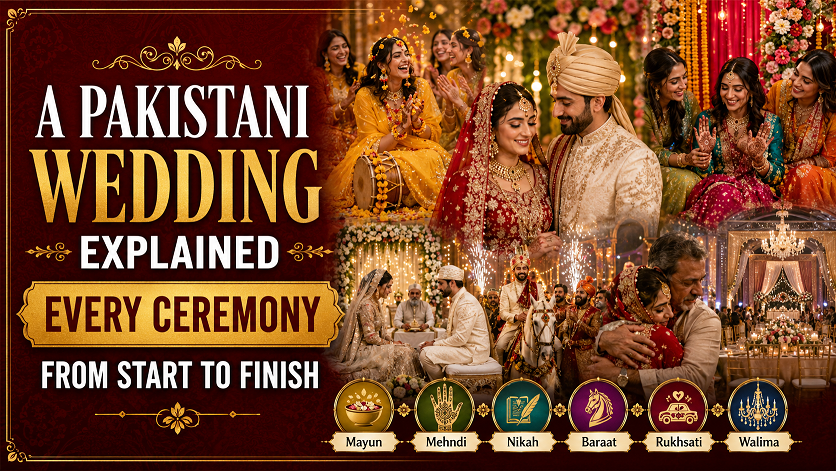
Pakistani wedding functions at a glance
| Event | Main meaning | What guests should know |
|---|---|---|
| Mangni | Engagement | May take place well before the wedding; it is not the Nikah. |
| Dholki | Informal gathering associated with songs and drumming | Often a smaller family event; entertainment varies. |
| Mayun or Ubtan | Pre-wedding preparation customs in some families | May be private or combined with another gathering. |
| Mehndi | Henna-related celebration | Can be separate for each family or jointly hosted. |
| Nikah | Muslim marriage contract and ceremony | May happen before, during or separately from the larger celebrations. |
| Baraat | The groom’s wedding party and arrival | The receiving celebration is often arranged by the bride’s side, though hosting can be shared. |
| Rukhsati | The bride’s farewell and departure | Often emotional; give the couple and close family space. |
| Walima | Marriage feast or reception | Traditionally associated with the groom’s side; size and timing vary. |
1. Mangni: the engagement
Mangni means engagement. In families that hold a separate engagement gathering, relatives may meet, exchange congratulations, share sweets and sometimes exchange rings or gifts. It can be an intimate meeting at home or a larger function.
An engagement is not the same as a Nikah. Do not assume that a couple is already married because you attended their mangni, saw rings exchanged or received a wedding announcement. Equally, a couple may have completed their Nikah before a later public celebration. Use the wording they choose rather than making assumptions.
For guests, the practical question is the level of formality. Ask whether the invitation is for a family tea, dinner or formal engagement event. There is no need to buy a heavily embellished wedding outfit for a gathering the hosts intend to keep simple.
2. Dholki, Mayun and Ubtan: smaller pre-wedding gatherings
A dholki gathering takes its name from a small drum and is associated with family singing and pre-wedding celebrations. It may be held at home, with relatives sitting together, sharing snacks and taking turns singing. Some families have several gatherings; others skip them entirely.
Mayun and ubtan are related to pre-wedding preparation customs in some households. Ubtan refers to a paste used in these rituals, while mayun can refer to the wider occasion or preparation period. The names, ingredients and activities are not identical across families.
If you are invited, follow the host’s lead about participating. You do not have to sing, dance or have anything applied to your skin. Ask before touching the bride, groom or their clothing as part of a ritual, and never assume that a playful custom gives permission to ignore someone’s boundaries.
3. Mehndi: the henna celebration
Mehndi refers both to henna and, in wedding conversation, to a celebration associated with it. The bride’s detailed henna may be applied separately because it takes time; a large Mehndi event can therefore be more about gathering and celebrating than watching the entire application.
Some celebrations include family dance performances, songs, a decorated stage and a meal. Others are quieter or women-only, with little or no musical entertainment. Bright yellow, green and orange are familiar choices, but they are not a required uniform.
Henna is also part of celebrations beyond Pakistan. UNESCO’s entry on henna rituals and social practices describes its role in social connection in the communities covered by that inscription. That broader context should not be mistaken for a claim that every Pakistani Mehndi follows the same customs.
For a guest, comfortable clothes and shoes are useful. Check whether the event is indoors or outdoors and whether the hosts have requested a theme. If henna is offered, accepting it is optional. Allow time for it to dry before handling your phone, clothes or food.
4. Nikah: the marriage ceremony, not just another party
The Nikah is the central marriage contract and ceremony in a Muslim wedding. It involves the couple’s agreement to marry and the relevant religious formalities. Guests may hear a religious address, the expression of acceptance and prayers, and may see the marriage document being signed.
It is more accurate to describe this as a marriage contract and acceptance than to promise an exchange of personalized vows. The exact procedure, seating and participation depend on the family’s religious practice and the person conducting the ceremony.
What is the Nikah Nama?
The Nikah Nama is the marriage contract document. Couples should understand its entries and conditions rather than treating it as a ceremonial prop for photographs. Questions about the contract, registration or individual rights belong with an appropriately qualified professional and the relevant local authority.
Pakistan’s Muslim Family Laws Ordinance, 1961 provides the marriage-registration framework. A wedding celebration is not a substitute for checking the applicable registration process. Requirements and administrative procedures should be confirmed for the couple’s jurisdiction; this cultural guide is not a marriage-registration checklist or legal opinion.
What does mahr mean?
Mahr is the bridal due owed by the husband to the wife. It is distinct from a guest’s wedding gift or salami, and from gifts supplied by the bride’s family. Quran 4:4 addresses giving women their bridal gift. The couple should understand and record their arrangements properly, rather than leaving them to assumptions.
What should guests do during the Nikah?
Silence your phone, remain quiet during the proceedings and follow the seating instructions. If it takes place in a mosque, ask about the entrance, footwear and clothing arrangements beforehand. Do not interrupt the ceremony for photographs or crowd the people completing the documents.
The Nikah may be held on the same day as the Baraat celebration or earlier, sometimes well before Rukhsati. Its position in a family’s schedule is not something guests need to judge or investigate.
5. Baraat: the groom’s wedding party and arrival
Baraat refers to the groom’s wedding party or procession. In everyday conversation, people may also use it to mean the main celebration at which that party is received. This explains why an invitation labelled “Baraat” can refer to a full evening event rather than only an entrance.
The groom arrives with relatives and friends, and the receiving family welcomes them. A formal venue might have an arranged entrance and photography; a home celebration may be much simpler. Music, dancing and elaborate transport are possibilities, not defining requirements.
The distinction between arriving and hosting matters. The groom’s side forms the baraat, while the bride’s side traditionally receives it and often hosts the associated celebration. Modern arrangements may be shared, combined or organized by the couple themselves.
As a guest, confirm whether you are meeting the groom’s party before departure or going directly to the venue. Leave entrances clear, follow parking instructions and avoid assuming that a procession permits unsafe driving or blocking public roads.
6. Rukhsati: the farewell
Rukhsati means departure or farewell. In a wedding setting, it commonly describes the bride leaving with her husband after saying goodbye to her family. It may happen at the end of the Baraat celebration, but a separate Nikah and later Rukhsati are also possible.
This is a social and family moment, not a second marriage contract. It can be emotional, joyful, understated or a mixture of all three. Do not expect the bride or her relatives to perform a particular reaction for the camera.
Keep the exit clear, let close relatives come forward and avoid posting emotional videos without permission. Some families include prayers or other farewell customs; others do not. Follow their lead instead of trying to direct the moment based on what you saw at another wedding.
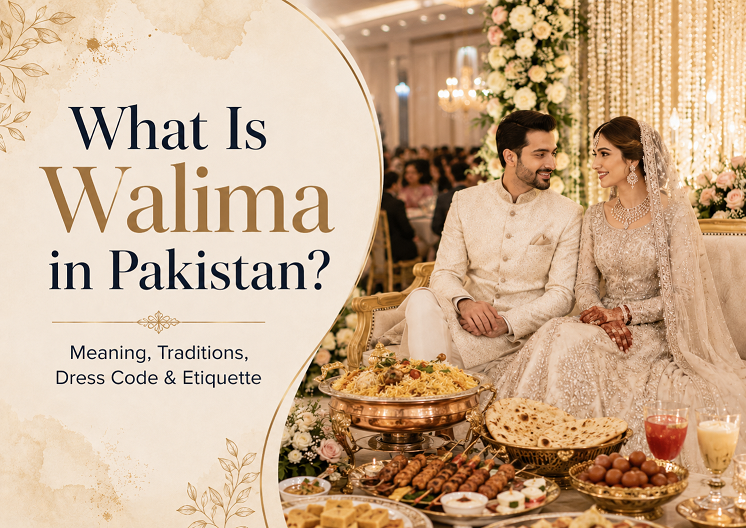
7. Walima: the marriage feast or reception
The Walima celebrates the marriage through a feast or reception. In Pakistan it is traditionally associated with the groom’s side, though the couple or both families may share the arrangements. It can be a modest meal, a restaurant gathering or a large reception.
Its connection to Islamic marriage tradition is reflected in Sahih al-Bukhari 6386, which records encouragement to hold a wedding banquet. That religious connection does not mean a luxury hall, designer clothing or a particular number of dishes is required.
Guests usually congratulate the couple, meet relatives, take photographs where welcomed and share food. The Walima is often after the main wedding celebration, but guests should follow the announced date rather than assume it must be the following evening. Questions about religious timing can be discussed with the family’s qualified religious adviser.
For a closer look at this event, read our guide to Walima in Pakistan. This overview keeps the focus on how it differs from Nikah, Baraat and Rukhsati.
Pakistani wedding traditions in order: example schedules
The following examples show how events can fit together. They are planning illustrations, not claims about a national average.
- A small celebration: a Nikah with close relatives, followed by a meal, with any further reception arranged according to the couple’s preferences.
- A three-event celebration: Mehndi on one day, Baraat with Nikah and Rukhsati on another, then Walima.
- A separate-Nikah arrangement: the Nikah takes place earlier; Mehndi, Baraat, Rukhsati and Walima are arranged later.
- A travel-friendly arrangement: selected celebrations are combined or scheduled over a weekend to reduce repeated travel and venue bookings.
For planning purposes, count invitations rather than assuming one event equals one day. Two functions may share a date but have different venues. Conversely, a single wedding invitation may cover several dates, only some of which apply to you.
What should guests wear to a Pakistani wedding?
The safest starting point is the invitation’s dress code, the venue and a quick question to the host. Formal South Asian clothing is welcome in many settings, but you do not have to buy a traditional outfit to be a respectful guest. A suitable suit, long dress or other modest formal clothing may work well.
Clothing by event
- Dholki or a home gathering: smart, comfortable clothing unless the hosts request something dressier.
- Mehndi: festive clothing with room to move; follow a color theme only if one is specified.
- Nikah: modest, polished clothing appropriate to the venue, with mosque-specific guidance checked beforehand.
- Baraat or Walima: formal shalwar kameez, a suitable lehenga or saree, a long dress, a suit, or traditional formal menswear according to the invitation.
Are white, black or red forbidden for guests?
There is no single Pakistani wedding rule banning all guests from wearing white or black. Family preferences and event styling differ. Red can look particularly bridal when combined with heavy bridal embellishment, but the issue is the overall outfit and the hosts’ expectations, not a universal ban on one color.
If you are unsure, send the host a photograph of the outfit you already own. Ask whether it suits the event before buying another. Avoid copying the bride’s full styling or treating a traditional outfit as a costume.
Consider comfort as well as appearance: outdoor lawns, stairs, hot weather and lengthy periods of standing can affect shoe and fabric choices. Bring a shawl or layer if the venue may be cool. You do not need a completely new wardrobe for every invitation.
Wedding gifts, cash envelopes and salami
Cash in an envelope is a familiar wedding gift in many Pakistani families. The term salami may be used for money given as a blessing or gift during wedding customs. Physical gifts are also possible, and some couples request no gifts or share a registry.
There is no universal minimum gift amount. Your relationship with the couple, your own budget and the family’s custom are more relevant than an online rupee figure. Do not borrow money or assume you must match the cost of your meal.
A labelled envelope and short congratulatory note help the family identify the sender. Give it to the couple or the person designated to collect gifts rather than leaving it unattended. If you attend several functions, you do not automatically owe a separate gift at each one.
For a physical gift, check whether the couple is travelling or moving abroad. A bulky household item can be inconvenient even when it is generous. Ask privately rather than questioning the couple about money, mahr or family contributions in front of other guests.
Guest etiquette: timing, greetings and photographs
Arrive for the stated time. Delays can happen, but deliberately arriving late because “Pakistani weddings always run late” risks missing the Nikah or meal. If the invitation separates arrival, ceremony and dinner times, plan around the part you have been invited to attend.
Respect the guest list. An invitation to Walima does not automatically include Mehndi, and a family invitation should not be assumed to include unlimited additional guests. Confirm partners, children and transport needs before the day.
Let people guide greetings. A warm verbal greeting and congratulations are enough. Do not assume everyone wants to shake hands, hug or be photographed, particularly across genders or during a private family moment.
Ask before posting. Permission to take a photograph is not necessarily permission to publish it. Be especially careful with children, women-only gatherings and emotional Rukhsati footage. Respect requests to keep phones away.
Check practical needs early. Ask a designated contact about step-free access, seating, prayer space, dietary requirements and a quieter area if needed. These questions are easier to handle before the couple is busy greeting guests.
What food is served at a Pakistani wedding?
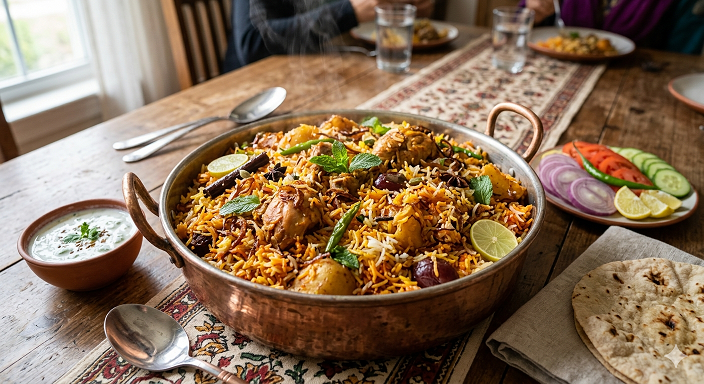
The menu depends on family preference, location, budget and applicable venue or local restrictions. You might encounter biryani or pulao, qorma, kebabs, naan, raita and desserts such as kheer or gulab jamun. That is a list of possibilities, not a promise that every reception offers all of them.
If the dishes are unfamiliar, our beginner’s guide to Pakistani cuisine explains common names and what to expect. Ask about ingredients rather than assuming a rice dish is vegetarian or a dessert is free from nuts or dairy.
Tell the host about allergies or dietary needs ahead of time and confirm with the caterer when necessary. Take a modest first serving if you want to try unfamiliar food, and decline additional helpings politely when you are full.
Chai may appear at a home gathering or after a meal, but it is not guaranteed at every function. If you are hosting a small family gathering yourself, our karak chai recipe provides a measured starting point for a creamy cardamom tea.
Wedding planning and costs: what to compare
There is no useful single “Pakistani wedding price.” A home Nikah, a restaurant Walima and a multi-event hotel celebration are different purchases. For a meaningful estimate, first decide the city, dates, guest count and number of events, then request written quotations for the same scope.
- Venue and catering: confirm guest minimums, menu, service, taxes, furniture, cooling or heating, backup power and any overtime charges.
- Photography: compare hours, number of events, team size, travel, edited photographs, video deliverables, delivery dates and privacy permissions.
- Clothing and tailoring: include alterations, fitting dates, accessories, footwear and cleaning rather than comparing only the advertised outfit price.
- Decoration: ask what is included, what costs extra and whether the quoted display can actually be delivered at your venue.
- Transport and accommodation: account for visiting relatives, accessible transport and travel between venues.
- Booking terms: read cancellation, rescheduling, refund and payment conditions before paying a deposit.
Keep a written total and a contingency amount the couple can afford. A smaller guest list or fewer separate bookings may be more effective than cutting essential comfort or food-service arrangements. Cost-sharing should be discussed explicitly rather than assumed from traditional hosting labels.
Ask the venue to confirm the rules that apply to its location and date, including event timing and food-service restrictions. Do not rely on a wedding blog for current local legal limits. This guide intentionally avoids invented package rates or a national average that hides major differences.
Frequently asked questions
How many days does a Pakistani wedding last?
It can be one day or several. There is no fixed length: families may combine functions, separate the Nikah from later celebrations or invite different people to different events. Check the actual schedule.
What is the difference between Nikah and Rukhsati?
Nikah is the Muslim marriage contract and ceremony. Rukhsati is the farewell and departure associated with the bride leaving with her husband. They may happen on the same day or at different times.
Is Baraat the same as Walima?
No. Baraat refers to the groom’s wedding party and arrival, and often the celebration receiving them. Walima is the marriage feast or reception traditionally associated with the groom’s side.
Do I have to attend every function?
No. Attend the events to which you are invited and tell the hosts which you can manage. If you cannot attend a particular function, a timely, courteous reply is more helpful than assuming all attendance is compulsory.
Can non-Pakistani or non-Muslim guests attend?
If invited, guests from other backgrounds can attend and celebrate with the family. Ask about arrangements for any religious venue, dress respectfully and observe quietly when unfamiliar with a ceremony.
Will there be music, dancing or alcohol?
Music and dancing depend on the hosts; some gatherings include them and others do not. Do not assume alcohol will be available, and do not bring it without an explicit invitation from the hosts.
Who pays for a Pakistani wedding?
Traditional hosting patterns may influence arrangements, but they do not tell you a particular couple’s agreement. The couple and families may share costs or keep events separate. Guests should not speculate about who paid for what.
The most useful rule: follow the invitation and the family
Knowing the event names helps you understand what is happening. Being a considerate guest comes down to simpler habits: confirm your attendance, arrive on time, dress for the setting, respect privacy and congratulate the couple without judging the size or style of their celebration.
For related reading, explore Walima traditions and guest etiquette or learn the food names in our Pakistani cuisine guide.
2 thoughts on “Pakistani Wedding Traditions Explained: Ceremonies and Guest Guide”