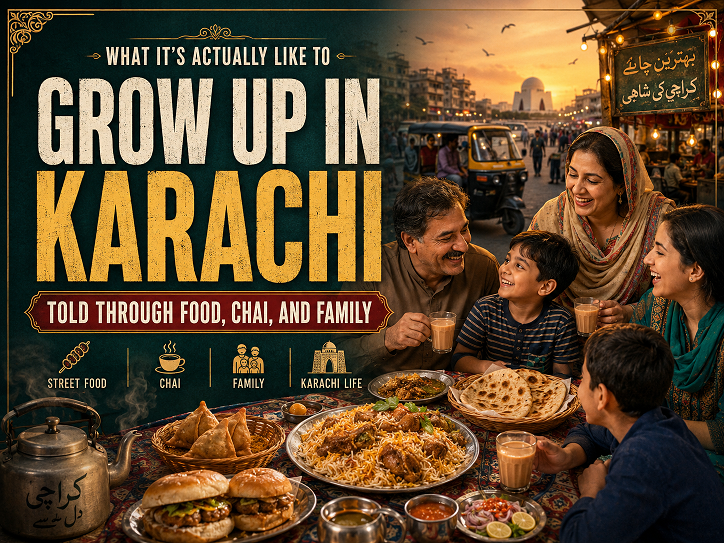
What is it like growing up in Karachi? Growing up in Karachi means growing up in one of the most crowded, chaotic, and quietly warm cities in the world — where the call to prayer competes with traffic horns, where a five-minute walk to buy bread turns into a 20-minute conversation with three different shopkeepers, and where the smell of frying samosas from a street cart is as familiar as your own street. It’s not a postcard version of Pakistan — it’s loud, sometimes inconvenient, occasionally frustrating, and somehow still home in a way that’s hard to fully explain to someone who didn’t grow up there.
Not a Travel Guide — Just What I Remember
There are a lot of articles online about Karachi — population statistics, “top things to do,” safety advisories. This isn’t one of those. This is just an attempt to describe what it actually *felt* like to grow up there, on an ordinary day, before I had any sense that it might one day seem unusual to someone else.
Some of this will sound familiar if you’ve read our piece on everyday life in Pakistan — but that piece was written looking outward, explaining patterns to someone unfamiliar with them. This one is written looking backward, trying to remember what those patterns actually felt like from the inside, as a kid who didn’t know any different.
A Typical Day, Looking Back
If I try to reconstruct an ordinary school day from memory, it goes something like this:
The Smell of Chai Before Anything Else
Before I was properly awake, I could smell chai being made in the kitchen. It wasn’t a sound that woke me up — it was the smell. By the time I was out of bed, there was already a cup waiting, often too hot to drink immediately, sitting on the table while my school uniform was being ironed.
Traffic That Felt Completely Normal
The drive to school involved a level of traffic — rickshaws, motorbikes weaving between cars, the occasional donkey cart — that I genuinely didn’t register as chaotic until years later, when someone visiting from abroad described it as “intense.” To me, it was just the road.
Snacks From the Same Few Stalls, Every Time
There were two or three specific food stalls near school that everyone went to — for samosas, for a specific kind of fried snack, for ice cream from a particular cart. You didn’t choose between options; you just knew which stall did which thing best, the way you’d know which restaurant in your neighborhood does what.
The House Filling Up
Evenings often meant the house slowly filling up — an uncle stopping by on his way home, a cousin who lived a few streets away, a neighbor returning a dish from earlier in the week. Nobody called ahead. The evening chai round (the one we wrote about in our piece on chai culture) often happened because of exactly this kind of unplanned gathering.
Dinner Late, Drama On
Dinner rarely happened before 8:30 or 9 PM, and it was almost always accompanied by whatever drama was airing that night — half-watched, half-discussed, with everyone weighing in on what a character should or shouldn’t have done.
The Food I Actually Remember
When people ask what food I miss most, the honest answer usually isn’t a “proper” dish — it’s the small, specific things. The taste of nihari from one particular shop that somehow never tasted the same anywhere else. The exact way bun kebab tasted from a cart near our house, wrapped in paper that always got slightly soggy by the time you finished it.
Halwa Puri Wasn’t a Treat — It Was a Ritual
Sunday mornings often meant halwa puri — a combination of fried bread, semolina halwa, and spiced chickpeas, usually picked up from a specific place that had been making it the same way for years. It wasn’t a “special occasion” food; it was just what Sunday tasted like.
Seafood From the Beach, Cooked at Home
Because Karachi is a coastal city, fresh seafood — fried fish, prawns — being grilled or fried at home, sometimes after a trip to the beach, was a fairly regular occurrence. It wasn’t until later that I realized this wasn’t necessarily true everywhere in Pakistan.
The 11 PM Food Run
It wasn’t unusual for someone to suggest, quite late at night, going out for food — and for a street stall or small restaurant to genuinely be open and busy at that hour. Late-night food culture wasn’t a “going out” activity; it was just an option that existed most nights.
Power Cuts and How They Just Became Normal
Load shedding — scheduled and unscheduled power outages — was simply part of life. There was a kind of unspoken schedule everyone seemed to know: certain hours were more likely to have outages, and households adjusted without much discussion. Homework got done with a flashlight or a UPS battery providing just enough light. Fans would stop, and a few minutes later, you’d hear the sound of a neighbor’s generator starting up somewhere down the street.
What’s strange, looking back, is how *unremarkable* this was. It wasn’t a daily crisis — it was a known inconvenience that everyone had quietly built routines around. You’d charge your phone when the power was on. You’d know which rooms stayed cooler during an outage. It was less “the power is out, disaster” and more “oh, it’s that time again” — closer to how someone elsewhere might react to traffic during rush hour.
A Strange Kind of Normal
I didn’t think of load shedding as a “hardship” growing up — it was just Tuesday. It was only after spending time somewhere where the power simply never goes out that I realized how much quiet adaptation had gone into making that disruption feel like nothing at all.
The Noise — And Why I Miss It
Karachi is loud. Traffic, vendors calling out what they’re selling, the call to prayer from multiple mosques at slightly different times creating a layered echo across the neighborhood, generators, construction, music from a wedding a few streets over. As a kid, I didn’t notice it as “noise” — it was just the sound of the world being awake.
It’s only in quieter places that I’ve come to realize how much that constant background hum was, in its own way, comforting. Silence, when I first encountered real silence, felt strange — almost like something was missing.
Family Everywhere, All the Time
One of the hardest things to explain to someone who grew up differently is just how *present* extended family was. Cousins weren’t people you saw on holidays — they were people you saw weekly, sometimes more. Aunts and uncles weren’t distant relatives with their own separate lives; they were part of the regular cast of people involved in day-to-day decisions, celebrations, and even minor arguments.
This connects directly to a lot of what we covered in our piece on everyday life in Pakistan — the unannounced visits, the multi-generational households, the constant flow of people in and out of the house. From the outside, that might look like a lack of privacy. From the inside, it just felt like never really being alone, in a way that — most of the time — felt like a good thing.
What I Only Realized After Leaving
It’s a strange thing — most of what makes growing up in Karachi distinctive isn’t visible to you while you’re living it. The chaos, the noise, the constant presence of family, the food stalls, the power cuts — none of it felt notable. It was just *life*.
It was only later, encountering other ways of living, that I started to understand which parts of my childhood were specific to that place and time, rather than just “how things are everywhere.” And honestly, a lot of what I now think of fondly are the parts that, on paper, sound like inconveniences — the unpredictability, the noise, the lack of personal space.
I think that’s true for a lot of people, regardless of where they grew up. The things that define a childhood are rarely the things anyone points out at the time. They’re just the texture of ordinary days — which, looking back, turn out to have been anything but ordinary.
If You’re Curious About More
This piece is part of a series exploring what daily life and culture in Pakistan actually looks like — from chai rituals to everyday surprises to wedding traditions. Each one comes from the same place: trying to describe what’s normal from the inside, for people seeing it from the outside for the first time.
Curious which chai style matches your personality?
Take our quick quiz to find out whether you’re a Karak, Doodh Pati, Sulaimani, or Masala chai person.
Frequently Asked Questions
What is it like growing up in Karachi?
Growing up in Karachi typically means a childhood shaped by a dense, busy, and diverse city — close-knit extended family, frequent visits from relatives and neighbors, a strong street food culture, and daily life that adapts around things like traffic, weather, and occasional utility disruptions. For many, it’s also a childhood filled with strong food memories, evening chai rituals, and a constant background hum of city noise and activity.
Is Karachi a big city?
Yes — Karachi is Pakistan’s largest city and one of the most populous cities in the world, serving as the country’s primary port city and economic hub. It’s an extremely diverse and densely populated urban area with a wide range of neighborhoods, from older established areas to newer developments.
What food is Karachi known for?
Karachi is known for a vibrant street food scene, including items like nihari, biryani (particularly Sindhi-style), bun kebabs, and a wide range of snacks and chaats. Its coastal location also means seafood is more prominent in Karachi’s food culture compared to many inland Pakistani cities. The city’s food culture reflects its diversity, with influences from many different communities that have settled there over generations.
What is load shedding?
Load shedding refers to scheduled or unscheduled power outages used to manage electricity supply shortages, common in many parts of Pakistan including Karachi. Households often plan around expected outage times, using backup power solutions like generators, inverters, or batteries, and it has become enough of a routine part of daily life that it’s factored into everyday planning.
1 thought on “What It’s Actually Like to Grow Up in Karachi — Told Through Food, Chai, and Family”