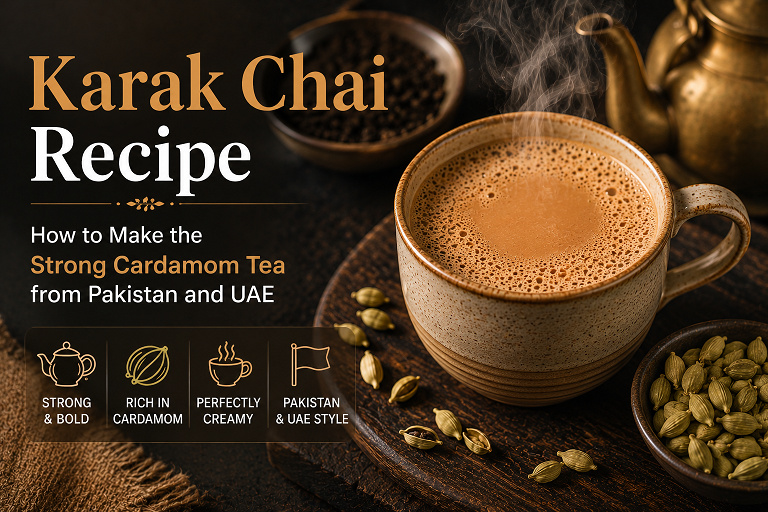
Karak chai is a strong, creamy cardamom tea made by boiling black tea with water, milk and sugar until the drink becomes rich, aromatic and deeply colored. It is especially popular in Pakistan and across the Gulf, where small roadside cafeterias serve it throughout the day.
This home-style karak chai recipe uses five everyday ingredients and takes approximately 15 minutes. Start with the quantities below, then adjust the strength and sweetness to suit your tea and saucepan. It makes two small servings; the final volume depends on how much liquid evaporates.
Jump to the recipe instructions or read on for ingredient substitutions and troubleshooting.
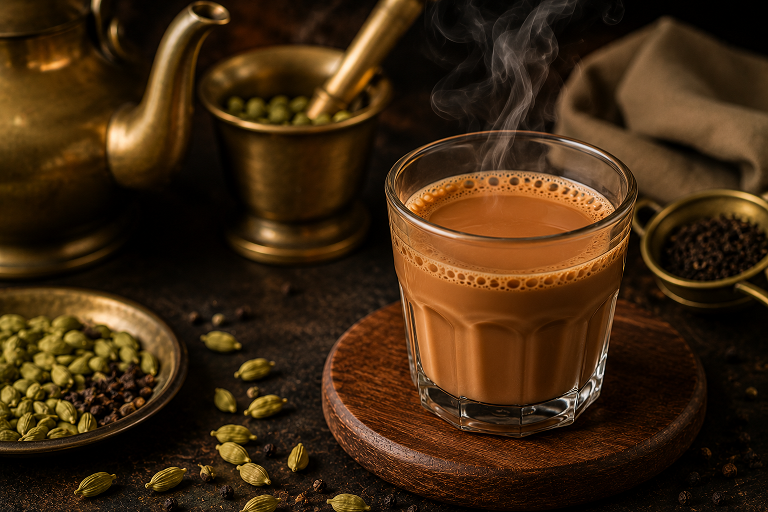
Quick recipe: Boil crushed cardamom in water, add strong black tea, then add milk and sugar. Simmer until slightly reduced, strain and serve hot.
- Prep time: 3 minutes
- Cook time: 12 minutes
- Total time: 15 minutes
- Yield: 2 small cups
- Cuisine: Pakistani and Gulf
- Diet: Vegetarian
What Is Karak Chai?
Karak chai is a milk tea known for its bold black-tea flavor and prominent cardamom aroma. Strength varies between households and cafés: there is no universal rule that karak must contain twice as much tea as masala chai or doodh patti. Simmering brings the ingredients together and can concentrate the drink as water evaporates.
The name reflects that strength. Kadak is commonly used in Urdu and Hindi to mean strong, while karak is the pronunciation widely used in the Gulf. South Asian workers and families helped popularize this style of tea in countries such as the United Arab Emirates and Qatar. Over time, it became part of everyday Gulf café culture as well.
There is no single compulsory formula. Some versions use fresh milk, some use evaporated or condensed milk, and others add saffron, ginger or cinnamon. Cardamom, strong black tea, milk and sugar remain the basic foundation.
For regional context, Visit Qatar’s karak tea guide describes the drink’s ingredients and place in everyday tea culture. In the UAE, Visit Dubai’s guide to karak cafés shows how widely it appears across the city’s food scene.
Karak Chai Ingredients
You need only five basic ingredients:
- 1/2 cup water: Water extracts the cardamom and tea before the milk is added.
- 2 teaspoons Assam CTC black tea: CTC tea gives karak chai its strong color and malty flavor. Two strong black tea bags may be used instead.
- 4 green cardamom pods: Lightly crush the pods so the seeds can release their aroma.
- 1 cup whole milk: Whole milk creates the richest texture, although reduced-fat milk also works.
- 2 to 3 teaspoons sugar: Adjust this according to taste.
Optional UAE-style additions: Add a small pinch of saffron or replace part of the sugar with 1 tablespoon of sweetened condensed milk. If using condensed milk, taste the chai before adding more sugar.
How to Make Karak Chai
- Crush the cardamom. Gently press the pods with the flat side of a spoon or the base of a cup. They should split open without being ground into powder.
- Boil the cardamom. Add 1/2 cup water and the crushed cardamom to a small saucepan. Bring to a boil and cook for about 2 minutes.
- Add the tea. Stir in 2 teaspoons of CTC black tea. Boil for 1 to 2 minutes, until the water turns a deep reddish brown. Avoid boiling it much longer because over-extracted tea can become harsh.
- Add milk and sugar. Pour in 1 cup milk and add 2 teaspoons sugar. Add saffron or condensed milk now if using.
- Bring it up carefully. Cook over medium heat and watch the pan closely. Milk tea can rise and overflow within seconds.
- Simmer and reduce. Once the chai rises, lower the heat. Simmer uncovered for 5 to 7 minutes, stirring occasionally. It should become slightly thicker and deeper in color.
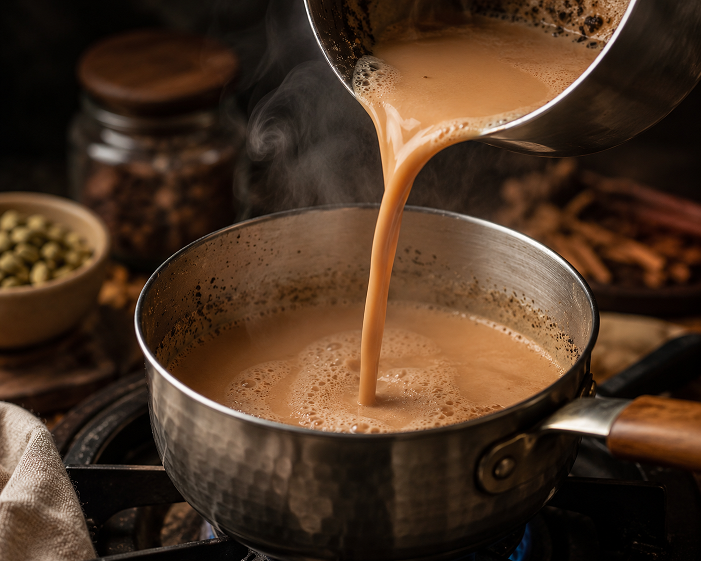
- Aerate if desired. Use a ladle to lift some chai and pour it back into the saucepan a few times. This creates light foam. Keep the ladle close enough to prevent splashing or burns.
- Strain and serve. Pour through a fine strainer into two small heat-safe cups. Serve immediately.
Important Tips for Better Karak Chai
Use Strong Black Tea
Assam CTC is ideal because its small processed leaves release color and flavor quickly and remain noticeable after milk and sugar are added. Delicate green, white or floral teas are not suitable for hard boiling.
Do Not Walk Away from the Pan
The most common karak chai accident is an overflowing saucepan. Use a pan with extra space and lower the heat as soon as the milk begins to rise.
Control Bitterness with Time
Strong chai does not have to taste burnt or excessively bitter. Boil the tea in water briefly, then let the longer simmer happen after adding milk. If the finished chai is bitter, reduce the initial tea-boiling time before reducing the quantity of tea.
Crush Cardamom Just Before Brewing
Freshly opened pods produce a brighter fragrance than pre-ground cardamom. Ground cardamom may also leave fine sediment in the cup. If it is your only option, start with approximately 1/8 teaspoon.
Adjust the Strength at the End
If the chai is too strong, add a small splash of hot milk. If it is too light, simmer it for another minute. Remember that additional simmering reduces the serving volume.
Karak Chai vs Masala Chai
| Feature | Karak chai | Masala chai |
|---|---|---|
| Main flavor | Strong black tea and cardamom | Black tea with a broader spice blend |
| Common spices | Cardamom; sometimes saffron | Cardamom, ginger, cinnamon, cloves and pepper |
| Texture | Rich and slightly reduced | Varies from light to creamy |
| Serving size | Usually a small cup | Often a regular cup or mug |
| Sweetener | Sugar or condensed milk | Usually sugar, jaggery or honey |
The names are sometimes used interchangeably, especially outside South Asia. In practice, karak chai usually emphasizes strength and cardamom, while masala chai emphasizes a mixture of spices.
Measurements, Serving Size and Scaling the Recipe
For this recipe, one cup means approximately 240 ml, not whichever drinking mug happens to be in the kitchen. Use about 120 ml water and 240 ml milk for the basic batch. A measuring teaspoon holds 5 ml, but the weight of a teaspoon of tea varies with the leaf size and how tightly it is packed.
The starting liquid is about 360 ml. Some evaporates during cooking, so the recipe makes two small servings rather than two full mugs. A wide saucepan loses liquid faster than a narrow one. If your pan leaves too little tea for two people, shorten the final simmer or add a little hot milk to adjust the finished quantity.
For four small servings, begin with 240 ml water, 480 ml milk, four teaspoons of tea and six to eight cardamom pods. Start with four teaspoons of sugar and adjust after tasting. Use a larger saucepan, but do not automatically double the cooking time: bring the mixture to the same gentle simmer and judge the flavor and reduction.
When making a larger batch for guests, strain it once it reaches the strength you want. Leaving tea leaves in the pot continues extraction and can make the last cup harsher than the first. Stir before serving so the milk and tea are evenly distributed.
Equipment to Buy—and What You Can Skip
You do not need an espresso machine, electric milk frother or expensive tea maker for stovetop karak. Before buying a chai equipment starter kit, check whether you already have the following three essentials.
A Small Saucepan with Room Above the Milk
Choose a saucepan with a comfortable handle and enough spare capacity for the milk to rise. A roughly one-litre pan provides useful headroom for this small batch. A heavy base helps distribute heat, but it does not prevent scorching if the heat is too high. For induction cooking, check that the base is compatible with your hob.
A Fine-Mesh Strainer
Choose a mesh fine enough to catch small tea particles and cardamom seeds. A strainer that sits securely over the cup makes pouring easier. Wash it soon after use so milk residue and tea leaves do not dry into the mesh. A reusable tea infuser can work, but loose ingredients need enough space for the liquid to circulate.
Heat-Safe Cups
Small ceramic cups are practical; heat-safe tea glasses make the color visible. When buying tea glasses for karak chai, check the manufacturer’s hot-drink suitability rather than choosing only by appearance. Ordinary decorative glassware may not be intended for near-boiling liquid.
How to Compare Tea and Spice Value
When shopping for Assam tea or cardamom, compare unit prices for the same pack weight. A larger packet is not automatically better value if you rarely use it. Start with a small pack of plain black tea before purchasing a bulk quantity. Keep tea and cardamom tightly closed, away from steam and strong kitchen odors.
Read premixed karak powder labels carefully. Some contain milk powder and sugar; others are only tea and spices. They are not interchangeable with the loose tea in this recipe. Follow the product’s own instructions first, and compare the amount of mix required per serving when evaluating cost.
Pakistani-Style and UAE-Style Variations
Pakistani Karak Chai
For a straightforward Pakistani version, use fresh whole milk, strong black tea, cardamom and sugar. Add a thin slice of fresh ginger in cold weather if you enjoy a sharper flavor. This variation is close to strong cardamom doodh patti.
UAE Karak Chai
For a Gulf café-style cup, add a pinch of saffron and 1 tablespoon of condensed milk. Some cafeterias use evaporated milk for a fuller body and a consistent result. If using evaporated milk, combine 1/2 cup evaporated milk with 1/2 cup regular milk.
Less-Sweet Karak
Start with 1 teaspoon sugar per batch. Strong black tea can taste more bitter when sweetness is reduced, so shorten the tea’s initial boil slightly rather than covering bitterness with extra sugar.
Dairy-Free Karak
Unsweetened oat milk gives the closest creamy texture. Use moderate heat because some plant milks separate when boiled aggressively. Almond milk works but produces a thinner drink and adds its own flavor.
Common Problems and Simple Fixes
| Problem | Likely cause | Fix |
|---|---|---|
| Chai tastes bitter | Tea boiled too long before milk was added | Limit the initial tea boil to 1–2 minutes |
| Chai looks pale | Weak tea or too much milk | Use Assam CTC and simmer slightly longer |
| Cardamom flavor is weak | Pods were old or left whole | Use fresh pods and crush them before boiling |
| Chai is too thick | It reduced for too long | Add a splash of hot milk |
| Milk forms small particles | Very high heat or acidic add-ins | Use fresh milk and reduce the heat after it rises |
Serving and Storage
Karak chai tastes best immediately after brewing. Serve it in small glass cups, ceramic teacups or heat-safe paper cups. It pairs well with paratha, biscuits, rusks, pakoras, samosas and lightly sweet baked foods.
For the best flavor and the simplest preparation, make only the amount you intend to serve. Do not leave milk tea sitting on the counter throughout the day. For guests, measure the ingredients in advance and brew a fresh batch close to serving time.
Frequently Asked Questions
What does karak chai taste like?
It tastes strong, milky, sweet and aromatic, with cardamom usually providing the dominant spice note. A long simmer gives it a fuller texture than ordinary milk tea.
Is karak chai the same as doodh patti?
They are closely related but not always identical. Doodh patti refers broadly to tea cooked with milk, while karak chai normally indicates a stronger, more concentrated cup, often flavored heavily with cardamom.
Can I make karak chai with tea bags?
Yes. Use two strong black tea bags for this two-cup recipe. Assam tea bags generally give the best flavor. Remove the bags before the final long simmer if the tea begins to taste bitter.
Does karak chai contain caffeine?
Yes. It is made with black tea and therefore contains caffeine. The exact amount varies according to the tea, quantity and brewing time. Because karak is concentrated, it may taste stronger than regular chai even though it is usually served in a smaller cup.
Can I use condensed milk?
Yes. Condensed milk adds both sweetness and richness and is common in Gulf-style versions. Begin with 1 tablespoon and reduce or omit the separate sugar.
Why did my karak chai become bitter?
The tea was probably boiled too long before the milk was added, or the leaves were unsuitable for strong boiling. Use Assam CTC, keep the initial extraction short and complete most of the simmering after adding milk.
Final Recipe Notes
The best karak chai balances four things: noticeable tea strength, fresh cardamom aroma, creamy milk and enough sweetness to soften the tea without hiding it. Start with the recipe above, then adjust only one element at a time. After two or three batches, you will know whether your ideal cup needs more cardamom, a longer reduction or less sugar.
For another brewing style, try our masala chai recipe from scratch. If you want a broader spice flavor, see our homemade chai spice mix. You can also browse the chai and recipes collection for more drinks and food pairings.
4 thoughts on “Karak Chai Recipe: Strong, Creamy Cardamom Tea”