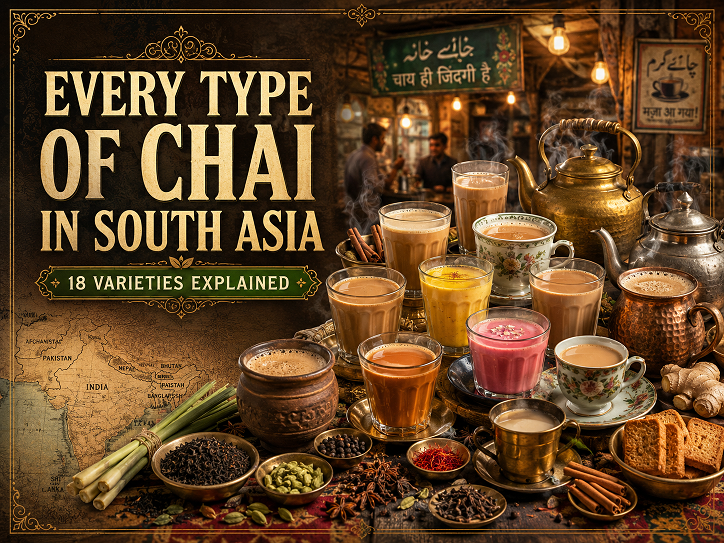
The types of chai you encounter across South Asia differ in more than their spices. Some emphasize milk, some are served without it, and others are identified by a preparation method or a small serving size. Doodh pati, masala chai, Kashmiri noon chai and Mumbai cutting chai therefore do not describe four perfectly separate recipes: their names tell you different things about the cup.
This guide explains 15 useful chai names, styles and serving traditions, with a particular focus on Pakistan, India and Kashmir. It is a starting point, not a complete inventory of South Asian tea culture. Recipes cross borders, spellings vary, and a household or café may use a familiar name for its own version.
Quick comparison · 15 chai styles · What to order · What to buy for home brewing · FAQs
Types of Chai at a Glance
Use this table to narrow down the flavor or texture you want. “Usually” matters: these descriptions are not ingredient guarantees for every vendor.
| Name | Usual character | What the name helps identify |
|---|---|---|
| Doodh pati | Milky, tea-forward | A milk-focused preparation |
| Karak or kadak chai | Bold; often sweet and creamy | A strong-style cup, with regional variations |
| Sada chai | Plain everyday tea | A simple local default rather than a fixed formula |
| Masala chai | Aromatic and spiced | The addition of a spice mixture |
| Sulaimani | Milk-free, often spiced and citrusy | A tea associated especially with Kerala’s Malabar region |
| Noon chai | Milky, salty and pink | A Kashmiri tea tradition |
| Kashmiri kahwa | Fragrant green tea without milk | A preparation often featuring saffron, spices and nuts |
| Irani chai | Rich, sweet milk tea | A café tradition especially associated with Hyderabad |
| Elaichi chai | Cardamom-led | A featured spice |
| Adrak chai | Ginger-led | A featured ingredient |
| Dum chai | Slow-prepared; often rich | A preparation method that can overlap with Irani chai |
| Cutting chai | A small portion of chai | Serving size, not a separate tea leaf |
| Tandoori chai | Hot-clay preparation and presentation | A finishing technique |
| Zafrani chai | Saffron-led | A featured ingredient |
| Lemon chai | Citrusy tea, usually without milk | A simple flavor description |

How to Read a Chai Menu
Before comparing names, separate four questions: what tea is used, whether milk is added, which flavors are included, and how the drink is served. This avoids treating every adjective on a menu as a completely new category.
A small glass of ginger-and-cardamom milk tea could be described as cutting chai, adrak chai or masala chai depending on what the seller wants to emphasize. Those descriptions can all be useful without being mutually exclusive.
Likewise, a creamy cup is not automatically the most caffeinated one. Milk creates body, spices create aroma, and sugar changes the balance of bitterness. None of those gives a reliable caffeine measurement. If you are new to the vocabulary, our guide to what masala chai means is a useful companion.
15 Chai Styles and Serving Traditions Explained
1. Doodh Pati: Milk-Focused Pakistani Chai
Doodh pati, also written doodh patti, is associated with a rich, milk-focused cup of Pakistani tea. Some versions cook the leaves directly in milk; others use water as part of the process. It is more useful to understand the intended body and flavor than to insist that any water makes the name incorrect.
For example, Izzah Cheema’s Pakistani chai recipe uses water before adding milk while also referring to doodh patti. It illustrates how home usage varies. Ask about the milk-to-water balance if you have a specific preference, and request sugar separately when possible.
2. Karak Chai: A Bold Cup with Regional Variations
Karak or kadak signals a strong-style tea, but there is no universal milk ratio or brewing time. Gulf karak commonly combines black tea, milk, sugar and cardamom; Visit Qatar’s karak guide describes that creamy, spiced profile.
The Gulf is outside South Asia, but its karak culture is relevant when comparing menus influenced by South Asian tea traditions. Do not assume a Gulf café’s karak and a Pakistani household’s strong chai will taste identical. For a home version, follow our karak chai recipe and adjust the sweetness to your preference.
3. Sada Chai: The Plain Everyday Option
Sada means plain, so sada chai usually communicates simplicity rather than an elaborate spice mixture. In a Pakistani milk-tea setting, it may mean the everyday combination of tea, water, milk and optional sugar. Elsewhere, the local default may differ.
It does not prescribe one exact sequence of ingredients. If you want no milk, say that explicitly instead of relying on “plain.” Similarly, “plain” need not mean unsweetened. This is a good choice when you want to notice the tea itself without cinnamon, cloves or other prominent aromatics.
4. Masala Chai: Tea with a Spice Blend
Masala chai pairs tea with spices, commonly alongside milk and sugar. Cardamom, ginger, cinnamon, cloves and black pepper are familiar possibilities, but there is no requirement to put every one into every batch. A ginger-heavy blend can taste very different from a cinnamon-heavy one.
Choose it when you want a layered spiced drink rather than a single dominant flavor. At home, start with a measured recipe and change one spice at a time. Our stovetop masala chai recipe gives you a practical starting point without needing a commercial concentrate.
5. Sulaimani: A Milk-Free Malabar Tea
Sulaimani is especially associated with Kerala’s Malabar region. It is commonly a clear black tea with spices, sweetness and a citrus finish, served without milk. Lemon is familiar, but the exact seasoning is not identical everywhere.
Dassana Amit’s Sulaimani recipe offers a concrete example of this spiced, milk-free style. It can suit someone who wants a less creamy drink, but “light” in appearance does not mean caffeine-free. Its cultural identity is also more specific than simply renaming every cup of black tea with lemon.
6. Kashmiri Noon Chai: Salty Pink Tea
Noon chai is a Kashmiri milk tea traditionally associated with salt and a pink color. Green tea, an alkaline ingredient such as baking soda, and the brewing process contribute to its distinctive appearance. Sheer chai is another name associated with this milky Kashmiri tea; it should not be listed as an unrelated green-tea category.
Sweet Pakistani pink chai is a related adaptation, not an exact description of every traditional salty cup. Tea for Turmeric’s pink chai recipe explicitly distinguishes its Pakistani version from traditional noon chai. When ordering “Kashmiri chai,” ask whether it is salty or sweet and whether nuts are included.
7. Kashmiri Kahwa: Fragrant Green Tea
Kashmiri kahwa is generally served without milk and commonly combines green tea with spices, saffron and nuts. The Budgam district guide to kahwa describes that combination and its traditional preparation in a samovar.
Its transparent appearance and aromatic profile make it quite different from pink milk tea. Do not count “kahwa” and “Kashmiri kahwa green tea” as two separate styles just to lengthen a list. Names such as kahwa or qahwa can have other regional meanings, so specifying the Kashmiri preparation helps. Anyone avoiding nuts should check both the brew and its garnish.
8. Irani Chai: Rich Café-Style Milk Tea
In the South Asian café context, Irani chai is particularly associated with Hyderabad and a rich, sweet milk-tea experience. Preparations can involve making a tea infusion and a reduced milk component separately before combining them. The name should not be interpreted as a description of all tea consumed in Iran.
Neha Mathur’s Irani chai recipe is one documented home interpretation, using reduced milk and identifying the drink with Hyderabadi dum chai. Café methods vary; neither a particular garnish nor a side dish of condensed milk is a universal defining feature.
9. Elaichi Chai: Cardamom in the Foreground
Elaichi chai highlights cardamom. It may be a simple milk tea with a few cracked green cardamom pods, or a house recipe in which cardamom stands out among other ingredients. The name tells you the main aroma rather than proving that no other spice is present.
This is a useful starting point if you enjoy fragrant tea but find a full spice blend too busy. When making it yourself, crack the pods so the seeds can infuse, then strain before serving. Ground cardamom can work differently and may leave more sediment in the cup.
10. Adrak Chai: Ginger-Led Tea
Adrak chai puts ginger at the center of the flavor. Fresh sliced, crushed or grated ginger is commonly used, and its intensity changes with the amount and preparation. It can appear alongside cardamom without ceasing to be recognizable as ginger tea.
Choose it for a sharper, warming flavor rather than treating it as a medical remedy. Ginger chai does not need promises about curing colds or improving digestion to be enjoyable. If a café’s ginger version is too intense for you, ask for less ginger on the next cup rather than assuming every adrak chai tastes that strong.
11. Dum Chai: A Preparation Term
Dum chai refers to a slow or covered preparation, and the term can overlap with Irani chai rather than identifying a completely separate drink. The important question is how that café prepares its tea and milk, not whether the name occupies its own box on a chart.
Do not assume that longer cooking always gives better flavor. Leaf size, heat and dilution matter. For home brewing, follow a specific recipe using appropriate cookware; do not improvise a pressure-tight seal on an ordinary saucepan. A menu description is not enough instruction for safely copying a café technique.
12. Cutting Chai: A Smaller Serving
Cutting chai is strongly associated with Mumbai and refers to a small, commonly half-size serving of chai. It is not a special leaf or an inherently different spice blend. Dassana Amit’s cutting chai guide describes the Mumbai style with tea, milk, ginger and cardamom.
The exact glass volume depends on the seller. A small portion can be convenient for a short break, but do not turn its name into a precise caffeine claim. Two vendors can serve similarly sized glasses using different quantities of tea.
13. Tandoori Chai: A Hot-Clay Finishing Method
Tandoori chai describes a preparation in which brewed chai meets a separately heated clay vessel, producing vigorous bubbling and a distinctive presentation. It is not simply ordinary tea served in any earthenware cup, and a smoky or earthy impression can vary with the method.
Aarti Madan’s tandoori chai demonstration documents one version of the technique. Treat it as a specialist hot-vessel process, not an invitation to heat a decorative mug over a flame. Thermal shock, unsuitable pottery and splashing hot liquid are good reasons to leave improvised experiments out of a beginner’s chai routine.
14. Zafrani Chai: Saffron-Led Tea
Zafrani chai emphasizes saffron. A café may use the name for a saffron-scented milk tea, while saffron also appears in other preparations such as kahwa. The term alone does not tell you whether the drink contains milk, nuts or several additional spices.
Ask what the base is before ordering. If you are buying a packaged saffron chai, check whether it contains saffron, flavoring, sugar or milk powder. A golden color is not, by itself, evidence of how much saffron was used or a guarantee of ingredient quality.
15. Lemon Chai: A Citrus Flavor Description
Lemon chai usually describes tea served with lemon, commonly without milk. Some versions are sweetened and others include ginger or spices. It is a broad flavor label rather than a single regional recipe with one fixed origin.
It can overlap with Sulaimani in ingredients without making the names interchangeable in every context. Choose it when you want citrus to lead, and check whether the vendor uses fresh lemon, syrup or a premix. If you also want milk, ask how the drink is prepared because adding acidic citrus directly to milk can cause separation.
Where Chai Latte, Dirty Chai and Spiced Milk Fit
A chai latte on a US café menu commonly combines a spiced tea base with milk, sometimes with foam. That base may be freshly brewed tea, a liquid concentrate or a powder. The name alone does not tell you the sweetness, tea quantity or preparation method.
Dirty chai adds espresso to the chai drink. It belongs in a discussion of modern café adaptations, not in a list presented as exclusively traditional South Asian tea varieties. Our dirty chai latte recipe explains how the coffee and chai components work together.
Sweetened cardamom milk without tea is another related drink, but it should be identified as spiced milk rather than counted as a tea variety. That distinction is useful for readers avoiding tea, although the complete ingredient list still matters.
Modern versions are not automatically inferior to home-brewed chai; they simply need accurate descriptions. A reader should be able to tell whether they are ordering a tea-led drink, a sweet café beverage or flavored milk without having to decode claims about “real” and “fake” chai.
How to Choose a Chai You Will Enjoy
Start with your preferred texture. For a creamy cup, explore doodh pati or a milk-based karak. For a clear tea without milk, consider Sulaimani, Kashmiri kahwa or lemon tea. Then decide whether you want cardamom, ginger, a spice mixture or a less aromatic plain tea.
Sweetness is a separate choice. Some shops brew sugar into a shared batch, while others can adjust individual orders. Ask before ordering rather than expecting sweetness to be removable after the drink is made. “Less sweet” and “no added sugar” also mean different things.
Four practical questions cover most unfamiliar menus:
- Is the drink made with milk, and which milk is used?
- Is sugar already included in the base?
- Which spice is most noticeable?
- What size is the serving, and can I order a smaller one?
For allergies, ask specifically about milk powder, condensed milk, nuts and shared preparation equipment. A transparent drink can still contain a nut garnish, and a plant-based milk substitution does not remove dairy already present in a premix. Our vegan chai latte guide provides one clearly dairy-free recipe approach.
What to Buy for Making Different Chai Styles at Home
You do not need a separate product for every name in this guide. For everyday black-tea milk chai, begin with a tea you like, milk, and one or two spices. A saucepan with comfortable headroom and a fine strainer are more useful than buying an entire shelf of flavored mixes before learning your preferences.
Choose a recipe first, then buy the tea it calls for. A fine-cut black tea intended for a robust milk brew is not automatically interchangeable with the green tea used in a Kashmiri preparation. Follow the packet and recipe together, especially when leaf size changes.
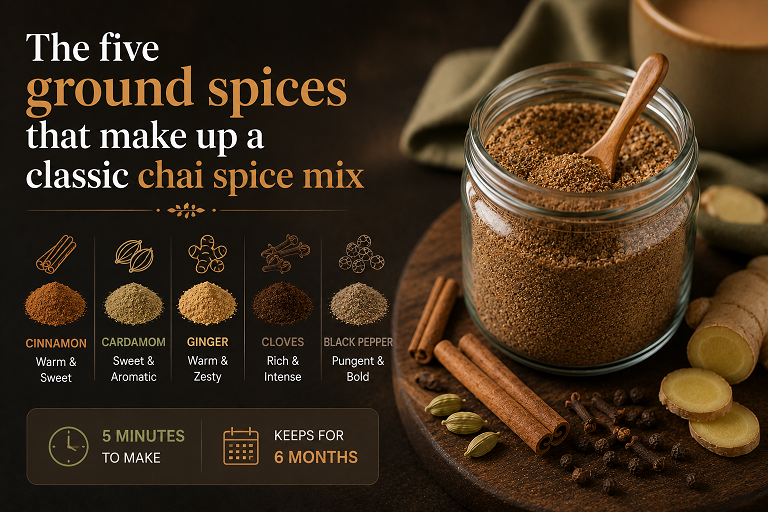
If you enjoy several spice-led variations, our chai spice mix recipe explains a reusable blend. Keep some whole cardamom and fresh ginger separately so you can make simpler cups instead of adding the full mixture every time.
For convenience, homemade chai concentrate separates brewing from serving. Commercial concentrates and instant powders can also be convenient, but compare the prepared cost per cup using the stated dilution and serving size. Bottle price alone is not a fair comparison when one product makes more drinks than another.
Read the ingredient list before buying: a tea-and-spice blend, sweetened instant powder and liquid concentrate serve different purposes. “Premium,” “authentic” or “strong” on a label does not explain how much tea, sugar or milk is present.
Frequently Asked Questions About Types of Chai
How many types of chai are there?
There is no single official count. Regional names, household recipes, featured spices and serving methods overlap. This guide explains 15 useful labels, not 15 mutually exclusive recipes or every tea tradition in South Asia.
What is the difference between karak chai and doodh pati?
Karak emphasizes a bold-style cup, while doodh pati emphasizes a milk-focused preparation. A drink can be both rich and strong. Neither label establishes a universal water ratio, and recipes vary between households and cafés.
Which chai has the most caffeine?
You cannot rank these names reliably without recipe and serving data. Tea quantity, extraction and portion size all matter. Green tea is not automatically caffeine-free, and adding milk does not remove caffeine. The FDA’s caffeine guidance also notes that decaffeinated tea can still contain caffeine. Ask the maker for product information when caffeine intake matters to you.
Is masala chai always very spicy?
No. The flavor depends on the spices and their quantities. “Spicy” may describe fragrance, ginger heat or pepper intensity, so be specific about what you like or dislike. A gentle cardamom-led mixture can be quite different from a pepper-heavy blend.
Can chai be made without sugar?
Yes. Home-brewed tea can be prepared without added sugar, although a commercial base may already contain it. Ask about the base rather than only requesting that no extra syrup be added.
Is chai tea an incorrect phrase?
Chai already means tea in several South Asian languages, so the phrase is repetitive when translated literally. In English café usage, however, “chai tea” often helps customers identify a spiced tea product. It is more helpful to explain the ingredients than to criticize someone for using the wording on a menu.
Bottom line: use chai names as clues, not guarantees. Ask about milk, sweetness, spices and serving size, then explore the versions that suit your taste. The variety comes from how people prepare and share tea, not from finding one rigid definition for every cup.
3 thoughts on “Types of Chai: 15 South Asian Tea Styles Explained”