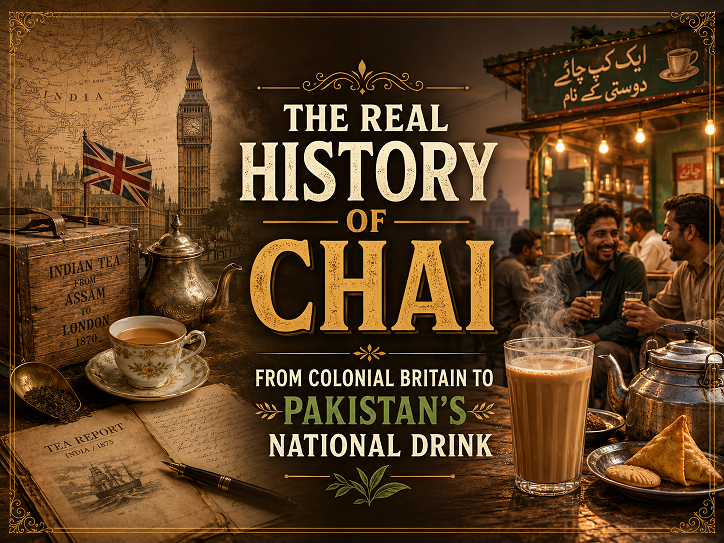
The history of chai is not a simple story in which Britain brought tea to a place that had never seen it. Tea drinking has a much older history in China, while tea plants and local knowledge already existed in Assam before British commercial plantations. Colonial rule then transformed tea into a vast export industry, often through coercive systems of land and labor. During the twentieth century, organized promotion helped turn tea into a mass-market drink within India. Households and vendors made it their own through local ingredients, techniques and social customs.
Pakistan inherited those developing tea habits at independence in 1947 and built distinctive traditions around milk tea, strong karak, doodh pati, cardamom, hospitality and the neighborhood chai stall. Modern Pakistani chai is therefore connected to China, Assam, British imperial trade, labor history, commercial advertising, Partition and generations of local adaptation.
History timeline · Tea in Assam · Colonial plantations · Domestic tea promotion · Chai in Pakistan · FAQs
Chai, Tea and the Problem with a Single Origin Story
The words “chai” and “tea” refer to a drink made from the leaves of Camellia sinensis, although everyday usage can also describe a prepared milk-and-spice beverage. The plant, the traded commodity and the finished cup each have a different history. Confusion begins when those histories are compressed into one origin claim.
The history of the tea plant is not the same as the history of British plantations in India. The rise of mass-market tea consumption is not the same as the development of masala chai. And the daily chai of Pakistan cannot be dated to one inventor, advertising campaign or recipe.
A careful account needs to hold several facts together:
- Tea cultivation and drinking have deep roots in China.
- Indigenous communities in Assam knew and used local tea before British plantation expansion.
- British capital and colonial government created an industrial plantation system in nineteenth-century India.
- The industry’s early commercial priority was largely export, especially for the British market.
- Domestic consumption expanded over time and was actively promoted in the twentieth century.
- South Asian consumers adapted tea in diverse ways rather than following one prescribed British preparation.
- After 1947, Pakistan’s tea culture continued evolving within a new national and economic setting.
This approach produces a more complicated story, but it also gives workers, Indigenous knowledge and local creativity their proper place.
A Concise History of Chai Timeline
| Period | Development | Why it matters |
|---|---|---|
| Long before the nineteenth century | Tea cultivation and drinking developed in China; communities in Assam also knew local tea plants. | The history did not begin with a British “discovery.” |
| 1820s | British accounts connected Robert Bruce with Assam tea through local Singpho knowledge. | Colonial records turned existing knowledge into a commercial opportunity. |
| 1830s onward | Experimental and commercial production expanded in Assam under British rule. | Tea became part of an imperial plantation economy. |
| Later nineteenth century | Plantations expanded in Assam, Darjeeling and other growing regions. | Production relied on land, capital, transport and a harsh labor system. |
| Early twentieth century | Indian tea increasingly appeared in workplaces, railway spaces, stalls and advertising. | A product grown mainly for export was being developed into a domestic mass market. |
| 1935 onward | The Indian Tea Market Expansion Board promoted tea consumption through organized campaigns. | Advertisements helped teach and normalize particular ways of preparing and serving tea. |
| 1947 | British India was partitioned and Pakistan became independent. | Existing tea habits crossed into new national histories, trade routes and identities. |
| Late twentieth century to today | Home tea, roadside chai, karak, café chai lattes and diaspora adaptations multiplied. | “Chai” became a family of drinks and a social practice rather than one fixed colonial recipe. |
The dates identify broad turning points. Adoption did not happen at the same speed in every city, class, language community or region.
Before Colonial Plantations: Tea in China and Assam
Many popular summaries begin with a Chinese legend that Emperor Shennong discovered tea when leaves fell into hot water. Legends can carry cultural meaning, but they are not the same as dated historical evidence. The safe conclusion is that tea use and cultivation developed in China long before it became an everyday British commodity or a South Asian plantation export.
Tea also grew in the ecological world stretching across parts of present-day northeast India, Myanmar and southwest China. In Assam, local communities—including the Singpho—possessed knowledge of tea plants and their use. Describing this as a British discovery erases the people who identified the plant and shared that knowledge.
Krishna Kanta Handiqui State Open University’s account of Assam tea notes that tea plants were abundant in Upper Assam and that Indigenous people brewed them before the British encounter. Robert Bruce’s 1820s observation belongs to the history of British recognition and commercialization, not to the first human knowledge of Assam tea.
That distinction is central. A resource can be new to a trading company while being familiar to people living where it grows. Colonial documents often presented European observation as discovery because that framing supported claims of expertise, ownership and commercial development.
Assam Tea and the British Search for a New Supply
By the early nineteenth century, tea was deeply embedded in British consumer life, while China was the main source of the imported product. British merchants and officials wanted greater control over supply and trade. Producing tea in British-controlled India offered a way to compete with Chinese tea and redirect profits through imperial networks.
After British authorities recognized Assam tea as commercially promising, experiments and plantations followed during the 1830s. Botanical questions mattered: growers worked with Assam varieties and also attempted to transfer plants, seeds and knowledge associated with Chinese production. But this was never only a story about botany. Land control, investment, colonial law, transport and labor determined whether experimental gardens became an industry.
The Indian Tea Association’s history of Assam tea places the Bruce encounter in 1823 and identifies the connection made through Maniram Dewan and the Singpho. Read alongside the India Culture account, it shows why the familiar “one Scotsman discovered Assam tea” sentence is inadequate.
Assam’s strong black teas later became particularly well suited to milk-based preparations. That flavor relationship helps explain their importance to modern chai, but the nineteenth-century plantation industry was not created in order to supply today’s roadside doodh pati or café latte.
The Colonial Plantation System: Production, Land and Labor
The expansion of tea transformed parts of Assam and other growing regions into plantation landscapes. Company estates required concentrated land, processing facilities, roads or river transport, managers and a large workforce. The polished image of an orderly tea garden can hide the coercive structures behind that growth.
Workers were recruited and moved under systems that sharply limited freedom and bargaining power. Colonial plantation labor in Assam included indenture, penal contracts, debt, isolation and severe discipline. The exact rules and experiences changed over time, but exploitation was not a minor footnote to a success story. It was part of how inexpensive export tea was produced.
Academic research on labor resistance in Assam plantations shows the scale of the workforce and industry by the end of colonial rule. Centering resistance also reminds us that workers were historical actors, not scenery behind planters and brands.
Plantation expansion affected land use and local communities as well as migrants brought to the estates. Later tea histories therefore cannot be reduced to an entrepreneurial tale of exploration and innovation. They must ask who controlled land, who performed the labor, who captured profits and whose knowledge was credited.
Darjeeling, the Dooars, Nilgiris and other growing districts developed their own histories and tea profiles. “Indian tea” was never one leaf from one landscape. Auction systems, grading, blending and global brands connected varied producing regions to buyers, while consumers often encountered a standardized packet far from the garden.

An Export Crop Before an Everyday Domestic Drink
For much of the nineteenth century, the plantation industry’s central goal was to sell tea into imperial and overseas markets. People within India certainly drank tea before national advertising campaigns, but mass domestic consumption should not be projected backward as if today’s chai stall had always existed beside the first estates.
British demand, shipping, auctions and industrial blending shaped what growers produced. Tea from different origins could be blended for consistency and price. The name of a growing region did not mean every British consumer received a single-estate product with a transparent chain of origin.
This export orientation created an apparent paradox: India became a major producer before tea became an equally widespread everyday habit among its own population. The paradox is easier to understand once tea is viewed as a colonial commodity. Production location and intended consumer market did not need to be the same.
The Tea Board India traces its institutional origins to the Indian Tea Cess legislation of 1903, which funded promotion of Indian tea within and outside India. Its later institutional history reflects the gradual importance of both export promotion and a domestic market.
How Tea Was Promoted to Indian Consumers
Domestic demand did not simply appear when plantations produced too much tea. Industry organizations used advertising, demonstrations, samples and public selling spaces to make the drink familiar. Railway stations, factories, offices, urban streets and printed media helped bring tea into ordinary routines.
In 1935, the Indian Tea Market Expansion Board was formed from earlier promotional structures. Historian Shobna Nijhawan’s peer-reviewed study of its Hindi advertising explains that tea drinking was not yet common throughout the Indian population in the first half of the twentieth century. Campaigns promoted both a product and ideas about its “proper” preparation, family life, work, energy and modernity.
The full study, “Nationalizing the Consumption of Tea for the Hindi Reader,” also shows how women were positioned within this advertising. Consumption history is therefore connected to gender and changing images of household life, not merely to sales totals.
Tea sellers and consumers did not just repeat the industry’s ideal cup. Vendors needed an affordable, appealing drink that could be made quickly and served in small portions. Households worked with their own budgets, cookware, milk, sugar and flavor preferences. This everyday experimentation helped create the broad range now described as chai.
From Tea to Masala Chai: Adaptation Without a Single Inventor
A tempting story says vendors added spices solely to reduce the amount of expensive tea they used, thereby defeating British instructions. Cost likely mattered in many settings, but it is too neat to present that explanation as the universal origin of masala chai. Spiced drinks and culinary uses of ginger, cardamom, pepper, cloves and cinnamon long predated the plantation industry.
What developed was not one standardized moment of invention. Black tea entered existing worlds of milk, sugar, spices, boiling, hospitality and street vending. Recipes then differed across regions and households. Some highlighted ginger or cardamom; some used several spices; some used little or no spice.
Milk and sugar also made robust tea appealing to many consumers, but they were not added in identical ratios. The modern category includes water-first chai, milk-heavy doodh pati, strong karak and clear teas without milk. Our corrected guide to types of chai in South Asia explains why a serving method, dominant spice and complete recipe can overlap.
For readers interested in the drink rather than the historical overview, our masala chai recipe provides a measured home method. No single recipe should be treated as proof of what every community drank a century ago.
Partition and the History of Chai in Pakistan
When Pakistan became independent in 1947, tea was already familiar across many parts of British India. Partition did not reset food and drink culture to zero. People, businesses, tastes and household practices moved through a violent political transformation and across new borders.
Pakistan did not inherit the major plantation regions that remained in India. Its tea culture consequently became strongly connected to imports as well as domestic blending, packaging and retail. A historical FAO market study of Pakistan described the country as highly dependent on imported tea. Its 2003 rankings and quantities are now dated, but the import-dependent structure remains historically useful.
That structure helps explain why tea in Pakistan can be culturally local even when the leaf was grown elsewhere. Agricultural origin and culinary identity are not the same. Kenyan or other imported black tea can enter a distinctly Pakistani preparation and social setting.
Tea also linked Pakistan with trade routes and tastes beyond India. Afghan, Iranian, Central Asian, Kashmiri and Gulf influences appear differently across regions and periods. Karachi, Lahore, Peshawar, Quetta, Islamabad and rural communities should not be flattened into one national recipe.
How Chai Became Part of Pakistani Daily Life
In Pakistan, chai functions as both a drink and a flexible form of hospitality. It can open a meeting, welcome a guest, accompany breakfast, mark a work break or extend a conversation after food. The cup may be ordinary, but the act of offering it can carry social meaning.
Home chai and commercial chai developed together. A household pot allows control over milk, tea and sugar; a dhaba or canteen turns the drink into public routine. Offices and shops build tea breaks into the working day. Weddings and family gatherings can involve entirely different scales of preparation.
Regional and household preferences matter. Cardamom may lead one family’s cup, while another uses plain black tea. Some prefer milk-heavy doodh pati; others want a stronger water-and-milk brew. Kashmiri pink tea, green tea, kehwa and other preparations coexist with everyday chai rather than sitting on a single ladder of authenticity.
Our article on why Pakistanis drink so much tea explores the social routine in more detail. Its old URL is retained, but “five times” should be understood as a cultural hook rather than a national consumption schedule for every person.
It is also inaccurate to call chai Pakistan’s official “national drink” without a clear government designation. Chai can be nationally important in practice without turning cultural popularity into a legal or official title.
Chai in the Gulf, Britain and the South Asian Diaspora
Migration carried South Asian tea practices into the Gulf, Britain, North America and elsewhere. In Gulf countries, karak developed into a prominent local everyday drink shaped by South Asian migration and regional ingredients and preferences. It should not be described as merely Pakistani tea abroad or as an entirely unrelated Gulf invention.
In Britain, tea already carried imperial history when postwar South Asian communities brought their own preparation practices and hospitality traditions. Grocery shops, restaurants and family kitchens made ingredients and styles visible to wider audiences.
In the United States, “chai latte” became a common café label. Many versions use sweetened concentrate or powder with steamed milk, while dirty chai adds espresso. These are modern commercial adaptations with their own history. They are neither exact copies of household masala chai nor evidence that adaptation began in Western cafés.
If you want to compare a café drink with a stovetop cup, see what masala chai is and our dirty chai latte recipe. Clear naming makes room for both without using “authentic” as a weapon.
What CTC Tea Changed—and What It Did Not
CTC means crush, tear, curl: a mechanized processing method that produces small, fast-brewing particles often used in robust black-tea blends and tea bags. Its efficiency and strong extraction make it practical for milk chai, especially when the tea is simmered or boiled.
CTC did not invent chai. It changed the industrial availability and brewing characteristics of much everyday black tea. Loose leaf is also not automatically whole leaf; loose CTC granules and dust grades are common. Packaging format and leaf grade answer different questions.
The growth of branded packets, blending and mass distribution made flavor more consistent across distant markets. At the same time, local consumers continued to control milk, sugar, spices and cooking time. Industrial standardization of the leaf did not standardize the final cup.
Readers comparing formats can use our loose-leaf tea versus tea bags guide. Choose according to the recipe and desired convenience rather than assuming the most expensive leaf is best for a strongly boiled milk drink.
Common Myths About the History of Chai
| Claim | More accurate explanation |
|---|---|
| “The British discovered tea in India.” | Assam tea and Indigenous knowledge existed before British commercial recognition and plantation development. |
| “Chai is an unchanged ancient Indian recipe.” | Modern milk-and-spice chai developed through long-standing culinary practices interacting with a newer colonial tea economy. |
| “Britain introduced everyone in India to tea at once.” | Consumption expanded unevenly over decades and was actively promoted through markets, media and public selling spaces. |
| “Masala chai has one inventor.” | No reliable evidence establishes a single inventor for the diverse household and vendor preparations. |
| “Pakistan grows the tea used in Pakistani chai.” | Pakistan’s tea market has historically depended heavily on imported leaf, which is locally blended, brewed and culturally adapted. |
| “All chai contains the same spices.” | Chai may be plain, single-spice, multi-spice, salty, milk-free or prepared in many other ways. |
| “Chai tea is historically wrong, so people should never say it.” | The English phrase is literally repetitive, but it functions as a recognized café category; ingredients matter more than policing customers. |
How to Evaluate Chai History Claims Online
First, check whether a source distinguishes legend from documented history. An origin tale can be interesting without proving a date. Second, ask whose perspective is centered. A narrative that names a British explorer but not the Singpho people who knew the plant is incomplete.
Third, look for separation between cultivation, export and consumption. Producing large quantities of tea in Assam does not prove that most South Asians were drinking modern chai at the same time. Fourth, be cautious with precise claims about “the first chai,” because household practices often leave fewer written records than companies and governments.
Finally, prefer sources that identify their evidence: legislation, advertisements, surveys, plantation records, oral history or scholarly research. A long article is not automatically a well-sourced one. This revised history includes direct links in the relevant sections so readers can follow the evidence rather than being told to search for it themselves.
Frequently Asked Questions
Where did chai originate?
The answer depends on what “chai” means. Tea drinking has ancient roots in China; tea plants and local use existed in Assam; the industrial Indian tea trade expanded under British colonial rule; and modern South Asian milk-and-spice chai developed through local adaptation. No single place and date adequately describes that entire process.
Did the British introduce tea to India?
They established and expanded a commercial plantation industry under colonial rule, but saying they introduced tea erases Assam tea plants and Indigenous knowledge. British institutions later promoted mass domestic consumption, which is a different historical claim.
Who invented masala chai?
There is no well-supported single inventor. It emerged through varied household and vendor practices combining plantation-grown tea with milk, sugar and spices already familiar in South Asian foodways.
When did chai become popular in Pakistan?
Tea habits had expanded in British India before Pakistan’s creation in 1947. After independence, imported tea, local brands, home routines, workplaces and tea stalls helped deepen its place in Pakistani life. Popularity developed across decades rather than beginning in one year.
Is chai officially Pakistan’s national drink?
Chai is extremely prominent in Pakistani culture, but this article does not claim an official legal designation without an authoritative government source. “National favorite” is a cultural description; “official national drink” is a formal claim requiring evidence.
Why is Pakistani chai often made with strong black tea?
Robust black tea stands up to milk and sugar, and small-particle grades brew quickly. Trade and brand availability also shape taste. This is a practical explanation, not evidence that every Pakistani household prefers the same tea strength.
Is modern café chai part of chai history?
Yes. Concentrates, chai lattes and dirty chai belong to the continuing global history of the drink. They should be described as modern adaptations rather than projected backward as the original form of South Asian chai.
Bottom line: chai’s history is a story of old tea knowledge, colonial extraction, worker labor, domestic marketing, migration and local creativity. Britain industrialized tea in India, but South Asian communities transformed what that commodity meant in daily life. Pakistan then carried that evolving tradition into its own homes, streets, workplaces and diaspora.
2 thoughts on “History of Chai: From Assam to Pakistani Tea Culture”