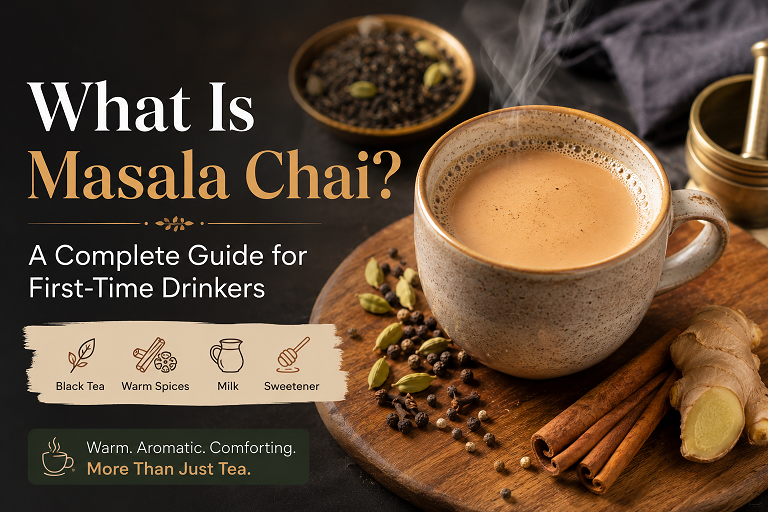
Masala chai is a South Asian spiced tea commonly made with black tea, spices, milk, water and optional sweetener. “Masala” refers to a mixture of spices, while “chai” means tea. The exact recipe is not fixed: one household may emphasize cardamom and ginger, while another uses cinnamon, cloves, pepper, fennel or no milk at all.
In the United States, the word “chai” often means a sweet spiced latte made from concentrate. That drink belongs to the wider modern chai category, but it should not be treated as the only definition of masala chai. Fresh stovetop chai, tea bags, powders and concentrates can produce noticeably different cups.
This guide explains what masala chai tastes like, what goes into it, how it differs from a chai latte, whether it contains caffeine and what to check when ordering or buying it. For exact measurements, use our separate masala chai recipe from scratch.
Meaning · Ingredients · Taste · Chai latte comparison · Caffeine · Buying guide
What does masala chai mean?
In everyday South Asian usage, chai simply means tea. Masala chai specifies tea prepared with a spice mixture. English menus may write the term as “masala tea,” “spiced chai” or simply “chai,” depending on what local customers recognize.
The phrase “chai tea” is literally repetitive because both words mean tea, but it is widely understood in English-language markets. Correcting a customer’s wording is less useful than explaining what the product actually contains. A café using “chai tea latte” may be signaling a spiced milk drink, not making a linguistic claim.
Masala chai is better understood as a family of preparations than as one protected formula. Black tea and warming spices are common, but quantities, brewing order, sweetness and the proportion of milk to water change from kitchen to kitchen.
Is masala chai Indian or Pakistani?
Masala chai is closely associated with South Asia and is prepared in both India and Pakistan, as well as in diaspora communities worldwide. Modern national borders do not provide a simple way to assign every shared food and drink tradition to only one country.
Assam black tea is a common base because its robust character can remain noticeable with milk and spices. The Tea Board India’s Assam information provides official context for that tea-growing region. Assam is useful, not mandatory: another black tea you enjoy with milk can work.
Claims that the finished modern drink has existed unchanged for thousands of years oversimplify its history. Spices have long histories in South Asian food and medicine, while tea cultivation, marketing and everyday consumption developed through later economic and cultural changes. For a broader discussion, see our history of chai.
What is in masala chai?
| Component | Purpose | Common choices |
|---|---|---|
| Tea | Provides body, aroma, color and caffeine unless decaffeinated | Assam, CTC tea, breakfast tea or another black tea |
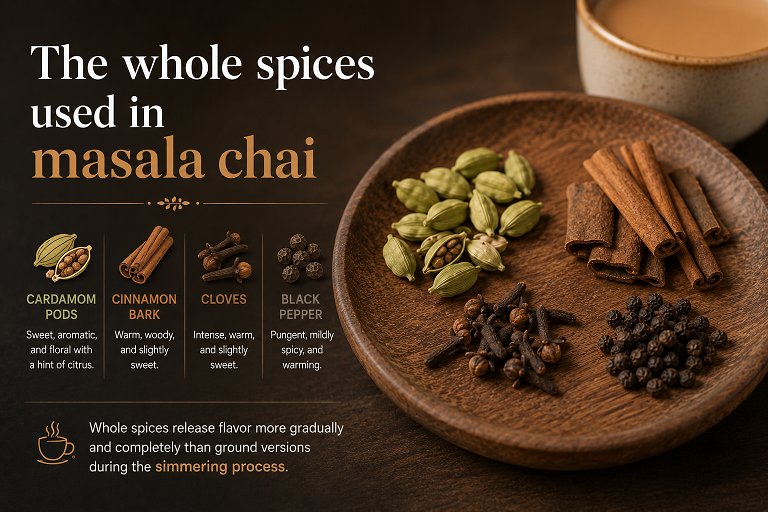
| Spices | Create the masala profile | Cardamom, ginger, cinnamon, cloves, black pepper or fennel |
| Water | Extracts tea and spice flavors | Quantity varies with the desired strength |
| Milk | Adds richness and softens astringency | Dairy milk or a suitable plant-based drink |
| Sweetener | Balances bitterness and spice when desired | Sugar, jaggery, honey or none |
Black tea
Small CTC-style tea particles brew quickly and can create a strong cup, which is helpful when milk is added. Loose whole-leaf tea can also work, but may require a different quantity or brewing time. The label “premium” does not automatically mean a tea is better suited to stovetop chai.
A tea that tastes pleasant plain may disappear behind milk and spices, while a very assertive tea can turn bitter if boiled too long. Start with a measured recipe and adjust one variable at a time.
Cardamom
Green cardamom gives a floral, citrus-like aroma and is one of the most recognizable chai spices. Lightly crushing whole pods exposes the seeds. Ground cardamom is convenient but can leave sediment and lose aroma faster after grinding.
Ginger
Fresh ginger provides a bright, sharp warmth; dried ground ginger tastes different and is easier to keep in a pantry. Neither is universally “correct.” Grated fresh ginger can be strong, so quantities should not be exchanged spoon for spoon without adjustment.
Cinnamon, cloves and pepper
Cinnamon contributes sweetness-associated aroma, cloves add a powerful warm note, and black pepper gives heat. Cloves can dominate quickly; the original post’s suggestion of several cloves per serving is not a universal starting rule. A balanced recipe often uses these more sparingly than cardamom.
Milk and water
There is no required one-to-one ratio. More milk generally creates a richer, softer cup; more water makes tea and spice extraction easier to control. Whole milk is not compulsory, and plant-based products vary in sweetness, flavor and heat stability.
Sweetener
Masala chai is often sweetened, but the quantity is personal. Sugar affects taste, not authenticity alone. When using a sweetened concentrate or flavored milk, taste before adding more.
What does masala chai taste like?
A well-balanced cup combines the briskness or maltiness of black tea with aromatic spice, milk and optional sweetness. It may be cardamom-forward and floral, ginger-forward and sharp, or peppery and intense. The milk rounds the tea’s astringency, but the finished drink should still taste like tea if that is the maker’s goal.
“Spicy” does not necessarily mean chili-hot. In this context it usually means flavored with spices. Ginger and pepper can add noticeable heat, while cardamom and cinnamon are aromatic rather than hot in the same way as chilies.
Masala chai is not automatically sweeter than coffee, healthier than another beverage or more complex than every café drink. Those comparisons depend on the recipe. A heavily sweetened homemade cup may contain more added sugar than a lightly sweetened commercial drink.
Masala chai vs chai latte
| Question | Stovetop masala chai | Typical café chai latte |
|---|---|---|
| Tea source | Tea leaves or bags brewed during preparation | May use concentrate, powder, bags or freshly brewed tea |
| Spices | Whole or ground spices chosen by the maker | Usually predetermined by the product or café recipe |
| Milk | Often heated with or added to the brewed tea | Frequently mixed or steamed separately |
| Sweetness | Can be adjusted directly | May be built into concentrate or powder |
| Consistency | Varies by household and each batch | Designed for repeatable service |
Not every café uses sweetened concentrate, and concentrate is not automatically poor quality. It is a preparation method that trades some customization for speed and consistency. Our chai concentrate buying guide explains how to compare dilution, ingredients and cost per serving.
A latte typically emphasizes milk and may include foam. Traditional-style masala chai need not have a foam cap. Both can be enjoyable; the useful question is whether the menu describes the drink accurately enough for you to choose.
What is a dirty chai?
A dirty chai combines chai with espresso. It contains both tea and coffee and is not part of a basic masala chai recipe. The espresso changes bitterness, flavor and caffeine, so it should be listed rather than assumed.
What is an iced chai latte?
An iced chai latte uses chilled tea or concentrate, cold milk and ice. It may have the same spice profile as a hot drink, but ice dilution changes strength. Our iced brown sugar chai latte shows one measured cold preparation.
Masala chai compared with other chai styles
Karak chai
Karak refers to strong tea and is particularly familiar in Gulf café culture as well as parts of South Asia. It is often milk-rich and cardamom-led, but recipes vary. It overlaps with masala chai without being a guaranteed synonym. Try our measured karak chai recipe for one version.
Doodh pati
Doodh pati is milk-forward tea associated strongly with Pakistan. The name points to milk and tea leaves. Describing it as “always entirely milk with zero water” is too rigid: household methods and the practical use of a splash of water can differ.
Elaichi chai and adrak chai
Elaichi chai emphasizes cardamom, while adrak chai emphasizes ginger. A single-spice cup may be called by that ingredient rather than masala chai. The naming is descriptive, not a formal certification system.
Noon chai
Kashmiri noon chai is a separate salted tea tradition usually based on green tea, with its recognizable color developed through a different process. It should not be presented as merely pink masala chai.
Whole spices vs ground chai masala
Whole spices are easy to crush, simmer and strain. They let you see what is in the pot and often produce less sediment. Ground spices work quickly and are convenient for small kitchens, baking and drinks where a little sediment is acceptable.
A pre-mixed spice jar contains spices, not necessarily tea, milk or sugar. Our homemade chai spice mix is a dry blend intended to be added in small amounts. A chai latte powder may contain all those other ingredients and needs its own directions.
“Natural” does not tell you the proportions or whether the flavor suits you. Check the actual ingredient list, allergen information, serving size and preparation directions.
Does masala chai contain caffeine?
Usually, because black tea naturally contains caffeine. The amount in a cup changes with the tea type, quantity, particle size, brewing time and serving size. Milk and spices do not remove caffeine; they only change the total volume and flavor.
The FDA’s caffeine guidance lists a typical figure for black tea while emphasizing that actual amounts vary. It also notes that decaffeinated tea still contains some caffeine. Therefore, a homemade recipe should not advertise one exact caffeine number without testing.
If you are sensitive to caffeine, choose decaffeinated black tea or a clearly labeled caffeine-free herbal blend and read the packaging. An herbal “chai” can share the spice profile but is not black tea. People concerned about pregnancy, a health condition or medication should seek individualized professional advice.
Is masala chai healthy?
Masala chai is a beverage, not a treatment. Tea and spices are researched in many contexts, but a kitchen recipe does not establish a therapeutic dose or guarantee benefits for digestion, immunity, blood sugar or inflammation.
Its nutritional profile depends heavily on milk, sweetener and serving size. Unsweetened tea differs from a large drink made with sweetened concentrate and added syrup. Anyone tracking sugar, calories, allergens or caffeine should examine the actual recipe or product label.
Do not add black pepper to “increase absorption” of unspecified compounds as a general health instruction. Add it because you enjoy its flavor and can consume it safely. Food blogs should avoid turning an optional spice into medical advice.
How is masala chai made?
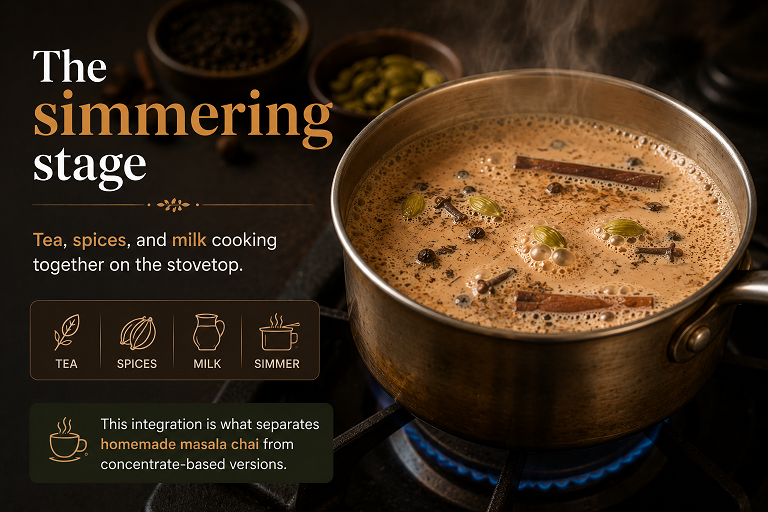
A common stovetop approach is to extract spices in water, brew the tea, add milk and sweetener, heat gently and strain. Some cooks add everything in another order. The best sequence depends on tea strength, spice form and milk behavior.
- Lightly crush whole spices so water can reach their aromatic interiors.
- Simmer them in measured water for a few minutes.
- Add tea and brew long enough for the desired strength without creating avoidable bitterness.
- Add milk and optional sugar, then heat gently while watching the pan.
- Strain into cups and serve hot.
This overview is not a standalone recipe because it lacks quantities. Use our complete masala chai recipe for measurements, substitutions and food-storage guidance.
Common first-time mistakes
Using too many cloves
Cloves are powerful and can cover the tea and cardamom. Begin with a restrained quantity and increase in a later batch. More spices do not automatically make a cup more authentic.
Boiling tea until it becomes harsh
Tea strength and bitterness are not identical. Use enough leaf for milk, control the brewing time and taste a cooled spoonful. A long rolling boil is not the only route to a bold cup.
Walking away from heating milk
Milk can rise and overflow quickly. Use a saucepan with headroom, moderate heat and active attention. Lower the heat when the mixture approaches a boil.
Expecting ground spice to dissolve
Cinnamon, cardamom and ginger powders can remain suspended or settle. Whisking and fine straining help, but they do not turn spice particles into syrup.
Changing every variable at once
If a cup is too weak, decide whether it lacks tea or spice before adding both. Record the tea, milk and spice quantities; adjust one component next time so the result is repeatable.
How to order or buy masala chai in the US
Before ordering, ask whether the café uses a concentrate, powder, tea bags or a freshly brewed base. Then ask whether the base is pre-sweetened. Those two answers reveal more than marketing terms such as “authentic” or “artisan.”
- For less sweetness: ask whether the sweetener is adjustable. It may not be if sugar is built into the concentrate.
- For stronger tea: ask whether an extra tea bag or less milk is possible; extra concentrate may also add sugar.
- For dairy-free: choose an available plant-based milk and check the concentrate or powder for dairy ingredients.
- For caffeine information: ask about the tea base and serving size rather than assuming all chai has less caffeine than coffee.
- For allergies: request ingredient and cross-contact information from the business.
When buying concentrate, compare the price per prepared serving, not only the bottle price. Check the dilution ratio, servings, added sugars, refrigeration instructions and how soon it should be used after opening. A larger bottle is poor value if much of it is discarded.
When buying loose tea or tea bags, look for a clear ingredient list and brewing directions. A flavored black tea may already include spices, while “chai spices” alone contain no tea. Choose the format that matches the work you actually want to do.
Frequently asked questions
Is masala chai the same as chai?
Chai means tea, while masala chai specifies spiced tea. In US café usage, “chai” often serves as shorthand for a spiced milk tea or latte, so context matters.
Is masala chai always made with milk?
Milk is very common, but recipes vary. A spiced tea without milk can still be described as masala chai in some contexts. Ask or read the recipe if dairy matters to you.
Is masala chai vegan?
It is vegan only when made without dairy and with suitable sweetener and packaged ingredients. Replacing dairy milk may be enough for a simple recipe, but commercial powders and concentrates need label checks.
Is masala chai gluten-free?
Plain tea, milk and individual spices do not normally rely on wheat, but a finished product’s status depends on its ingredients and cross-contact. Check packaged blends and café procedures for your requirements.
Can children drink masala chai?
Standard black-tea chai contains caffeine and may contain considerable added sugar. Parents or caregivers should consider the child’s age, serving size and professional guidance rather than treating it as an ordinary caffeine-free milk drink.
What is the best masala chai?
There is no universal winner. A cardamom-forward homemade chai, unsweetened loose-leaf blend and sweet café latte serve different preferences. Compare tea strength, spice balance, sweetness, milk and preparation effort.
A flexible drink, not a single formula
Masala chai is defined broadly by tea and spices, then shaped by the person making it. Understanding that flexibility makes it easier to order, shop and brew without treating one commercial product or household recipe as the only real version.
5 thoughts on “What Is Masala Chai? Meaning, Ingredients and Taste”