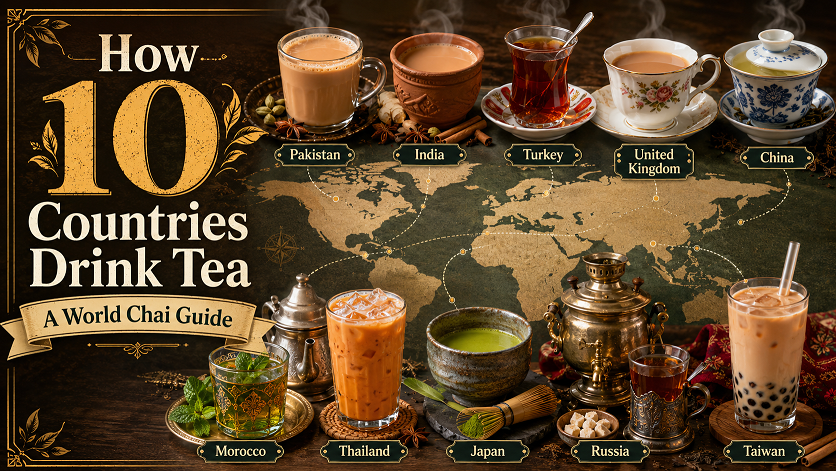
How different Countries Drink Tea? Tea is made from the same plant across the world — but what people do with it varies so dramatically from country to country that it’s almost unrecognizable as the same drink. Pakistan boils it in milk with spices. Japan turns it into a powdered ceremony. Morocco pours it from a height to create froth. Turkey brews it in a two-pot system. Britain bags it and adds milk at the end. Here are ten countries, ten completely different relationships with tea — and what each one reveals about the culture it comes from.
One Plant, Ten Completely Different Relationships
All tea — black, green, white, oolong — comes from a single plant: Camellia sinensis. The differences between tea types come from how the leaves are processed after harvest. But the far greater variation is what different cultures have done with the tea once it’s in their hands.
This isn’t just an interesting footnote about a beverage. The way a culture prepares and drinks tea tells you a lot about its values — what it prioritizes in social interactions, whether hospitality is formal or casual, whether the drink is functional or ceremonial, and how much time the culture is willing to give to the act of drinking.
🇵🇰 Pakistan — Chai
Pakistan
Doodh Pati / Karak / Masala Chai
Pakistan’s relationship with chai is inseparable from its social fabric — as we’ve written about extensively on this site. The dominant styles are Doodh Pati (tea boiled entirely in milk), Karak (strong, concentrated), and Masala (spiced). Chai is consumed 4–6 times a day on average, is automatically offered to any guest who enters a home, and accompanies virtually every social interaction. It’s brewed fresh, always hot, and almost never from a bag. The comparison to other countries’ tea cultures makes clear what sets Pakistan apart: the intimacy and frequency of the ritual, and the expectation that tea is made carefully rather than conveniently. See our full guide to Pakistani chai culture and our breakdown of all 18 chai varieties.
🇮🇳 India — Masala Chai
India
Masala Chai / Cutting Chai
India’s chai culture is closely related to Pakistan’s — both emerged from the same colonial-era tea promotion campaigns and share Punjabi culinary roots. The signature Indian contribution to global chai culture is “Cutting Chai” — small, half-size portions served quickly from street stalls, designed for a fast break. India also has a stronger culture of street-side chai wallahs (tea sellers) who are central to urban daily life. Regional variations are significant — Irani chai (condensed milk), Kashmiri Kahwa (green tea, saffron), and various spiced versions all exist within the same country.
🇹🇷 Turkey — Çay
Turkey
Çay (black tea, no milk)
Turkey is among the world’s highest per-capita tea consumers, and Çay (pronounced “chai” — the same word) is the country’s defining social drink. Turkish tea is brewed in a distinctive two-pot system: a large kettle below provides hot water, and a smaller pot on top holds a concentrated tea brew. The two are combined to each person’s preferred strength. Served in small tulip-shaped glasses that show the tea’s deep red color, always with sugar cubes on the side but never with milk. Tea gardens (çay bahçesi) are central to Turkish social life — analogous to the pub in British culture.
🇲🇦 Morocco — Atay
Morocco
Atay (Maghrebi mint tea)
Moroccan mint tea — brewed from gunpowder green tea with fresh mint and a significant amount of sugar — is one of the most theatrical tea rituals in the world. The host pours the tea from a height of 12–18 inches into small glasses, creating a characteristic froth, then pours it back into the pot, repeating the process multiple times to mix and aerate the tea. It’s always served three times: the first cup is said to be “bitter as life,” the second “strong as love,” and the third “gentle as death.” Refusing the offer is considered rude.
🇯🇵 Japan — Matcha & Sencha
Japan
Matcha / Sencha / Gyokuro
Japan has perhaps the world’s most formalized tea culture. The traditional tea ceremony (Chanoyu) — an elaborate practice involving specific movements, tools, and etiquette — is still practiced today as both a social art and a meditative practice. But Japan also has an entirely separate everyday tea culture, where Sencha (steamed green tea) is drunk routinely, and where canned and bottled tea is more widely available in vending machines than any other country. Matcha — powdered green tea whisked with water, no milk in the traditional form — has become globally influential in recent years.
🇬🇧 UK — Builder’s Tea
United Kingdom
Builder’s Tea / English Breakfast
British tea culture occupies a unique position — steeped in history (pun fully intended), intensely democratic, and the subject of endless debate on the correct preparation method. A typical British cup involves a tea bag steeped in boiling water, with milk added — the debate about whether milk goes in before or after the water is a genuine cultural flashpoint. Tea in the UK is consumed at a rate that makes it a genuine national habit: several cups a day, offered automatically in social situations, and closely tied to the pause structure of the working day (“tea break” is a real institution).
🇨🇳 China — Gongfu Cha
China
Gongfu Cha (Oolong, Pu-erh, White)
China is the origin of tea culture — all tea comes from plants first cultivated here, and Chinese tea traditions span thousands of years. The Gongfu Cha method involves brewing high-quality loose-leaf tea in a small clay teapot using multiple short infusions — each steeping typically lasts only 20–60 seconds, and the same leaves might be infused 5–10 times, with each infusion revealing different flavor notes. No milk, no sugar — the focus is entirely on the tea itself, its aroma, and the experience of tasting how it evolves over multiple pours.
🇷🇺 Russia — Zavarka
Russia
Zavarka (samovar tea)
Russia has a long tea tradition centered on the samovar — a heated metal container that keeps water hot throughout the day. Tea is brewed as a strong concentrate (zavarka) in a small teapot on top of the samovar, then diluted with hot water to individual strength in a cup or glass. A distinctive feature of Russian tea culture: sugar is often not dissolved in the tea but held in the mouth or between the teeth and the tea drunk through it. Jam (especially raspberry) is also a common sweetener, stirred in or eaten alongside.
🇪🇬 Egypt — Shai
Egypt
Shai (black tea, sometimes mint)
Egyptian tea — called Shai — is strong black tea brewed with a significant amount of sugar, sometimes with fresh mint added. It’s consumed throughout the day in small glasses at ahwas (traditional coffeehouses), which are central to Egyptian social life. Tea in Egypt is almost always very sweet by Western standards, and offering tea to guests is a fundamental hospitality gesture similar to Pakistan’s chai culture. Some regions also drink koshary shai — tea with milk, influenced by colonial-era British tea habits.
🇦🇷 Argentina — Yerba Mate
Argentina
Yerba Mate
Strictly speaking, Yerba Mate is not made from the Camellia sinensis plant — it comes from a different species. But it’s included here because it functions culturally as the regional equivalent of tea: a daily hot beverage with significant caffeine, deep social meaning, and a specific preparation ritual. Mate is brewed in a hollowed gourd and drunk through a filtered metal straw (bombilla). The same gourd is passed among a group, each person drinking fully before passing it on — a communal ritual that has no real equivalent in any other tea culture covered here.
Quick Comparison — All 10 Countries
| Country | Tea Name | Milk? | Sweet? | Key Feature |
|---|---|---|---|---|
| Pakistan | Chai (Doodh Pati) | Yes, boiled in | Yes | Tea boiled in milk, not water |
| India | Masala Chai / Cutting Chai | Yes | Yes | Street culture, small portions |
| Turkey | Çay | No | Sugar separate | Two-pot double-brew, tulip glasses |
| Morocco | Atay | No | Very sweet | Poured from height, 3-glass ritual |
| Japan | Matcha / Sencha | No (traditional) | No | Ceremonial, multiple infusions |
| UK | Builder’s Tea | Yes (after) | Optional | Tea bag, milk debate |
| China | Gongfu Cha | No | No | Short multiple infusions, clay pot |
| Russia | Zavarka | Rarely | Jam or sugar | Samovar, concentrate + dilution |
| Egypt | Shai | Sometimes | Very sweet | Strong, café culture |
| Argentina | Yerba Mate | No | Traditionally no | Communal gourd, passed around |
What All 10 Have in Common
Despite the enormous differences in preparation, every culture on this list shares the same underlying use of tea: as a social anchor. In every country, tea is what you offer someone who visits, what you drink when you pause, and what you share when something important needs to be discussed. The drink changes entirely; the function stays the same.
Which Pakistani chai style is yours?
Now that you’ve seen how the world drinks tea — find out which Pakistani chai variety matches your personality.
Frequently Asked Questions
What country drinks the most tea?
China produces and consumes the most tea by volume overall. However, when measured by per-capita consumption, countries like Turkey, Ireland, and the UK consistently rank among the highest tea-drinking nations. Pakistan and India also rank very high in total tea consumption. The answer depends on whether you’re measuring total volume or per-person consumption.
How is tea different in different countries?
Tea varies enormously by country in terms of preparation, ingredients, temperature, and social context. Pakistani and Indian chai involves boiling black tea with milk, sugar, and spices. Japanese tea ceremony uses powdered matcha without milk or sugar. Moroccan mint tea is prepared with gunpowder green tea and fresh mint. British tea is typically a bag steeped in hot water with milk added. Each tradition reflects a unique cultural relationship with the same plant.