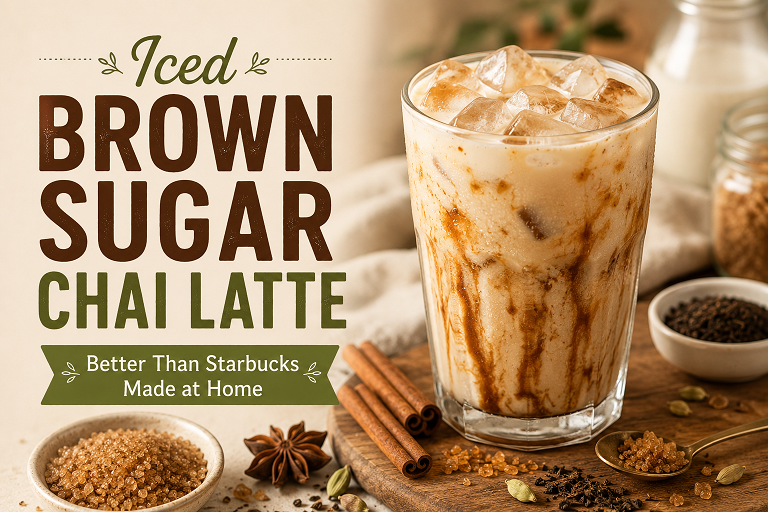
This iced brown sugar chai latte combines strong spiced black tea, a quick brown sugar syrup and cold milk over ice. Cinnamon and cardamom give it a warm aroma, while the chilled tea keeps the drink refreshing rather than heavy.
The recipe makes one large serving and needs only a saucepan, a strainer and a glass. You can brew the tea from scratch or use a suitable chai concentrate. The important step is cooling the tea before adding ice; otherwise, a flavorful brew can turn watery as the ice melts.
Jump to recipe · Brown sugar syrup · Concentrate shortcut · Troubleshooting · Make-ahead and storage

What is an iced brown sugar chai latte?
It is a cold milk-and-tea drink sweetened with brown sugar and flavored with chai spices. There is no espresso in the main recipe. Adding coffee creates a dirty-chai variation, which is optional.
This version uses a cardamom-infused black tea base and cinnamon-cardamom syrup. It is deliberately simpler than a full whole-spice masala chai. If you want to learn the broader spice-and-tea method, see our masala chai recipe from scratch.
The drink is an independent homemade recipe, not a verified copy of a named café product. Its main advantage is control: you choose the tea strength, syrup quantity, milk and serving size without needing a particular brand.
Iced brown sugar chai latte recipe
Yield: 1 large serving
Preparation and assembly: approximately 5 minutes
Heating and brewing: approximately 8 minutes
Additional chilling: allow approximately 15–30 minutes with an ice-water bath, or longer in the refrigerator
Total: approximately 28–43 minutes from scratch, depending on cooling
If the tea and syrup are already cold, assembly takes only a few minutes. The chilling estimate is not a guarantee: use the ingredients when cold rather than pouring warm tea over ice to meet a timer.
Ingredients for the tea
- 150 ml water for brewing
- 2 teaspoons loose black tea, or 2 standard black tea bags
- 2 green cardamom pods, lightly crushed
You will measure 120 ml (½ US cup) of the strained, chilled tea for the drink. Starting with a little more water allows for evaporation and liquid retained by the leaves. If the yield is slightly short, top up to 120 ml with drinking water.
Ingredients for the syrup
- 2 level tablespoons packed brown sugar
- 1 tablespoon water
- ¼ teaspoon ground cinnamon
- A small pinch of ground cardamom
This makes one small batch of syrup. Start by adding half of it to the latte, then use more if you want a sweeter drink. Using all the syrup adds the full 2 tablespoons of brown sugar.
For assembly
- 120 ml (½ US cup) chilled tea from the preparation above
- 240 ml (1 US cup) cold milk of choice
- Approximately 1 cup ice cubes, adjusted to fit the glass
- Half to all of the cooled syrup, according to taste
Use a glass of approximately 600 ml capacity or larger so there is room for the milk, tea and ice. If your glass is smaller, divide the drink between two glasses rather than reducing ingredients unpredictably.
Instructions
- Infuse the cardamom. Bring the 150 ml water and crushed pods to a gentle simmer in a small saucepan. Simmer for approximately 2 minutes. Avoid boiling the small quantity of water rapidly.
- Brew the tea. Remove from the heat, add the loose tea or tea bags and cover. Steep for approximately 3–4 minutes, adjusting to the tea’s instructions and strength. Strain out the leaves and cardamom, or remove the bags and strain the pods.
- Measure and chill. Measure 120 ml of the strained tea into a heatproof container. Set the container in an ice-water bath, keeping bath water out of the tea. Stir occasionally and refrigerate as needed until cold. Do not place a fragile hot glass directly into ice water.
- Make the syrup. In the small saucepan, combine the brown sugar, tablespoon of water, cinnamon and pinch of cardamom. Heat gently, stirring, for approximately 1–2 minutes until the sugar dissolves. Remove from the heat without reducing it to a thick caramel.
- Cool the syrup. Transfer to a small heatproof container and cool. Ground spices will remain suspended or settle; they do not dissolve like sugar. Stir before dividing the syrup.
- Assemble. Mix half the syrup with the chilled tea. Put ice in the serving glass, pour in the sweetened tea and add the cold milk. Stir thoroughly, taste and add more syrup a little at a time if desired.
- Serve immediately. Add a straw or long spoon if useful. The flavor changes as ice melts, so enjoy it soon after assembly.
How to make brown sugar syrup for chai
The syrup uses two tablespoons of sugar to one tablespoon of water, measured by volume before heating. Keep that formula consistent when scaling. This is not a one-to-one simple syrup, and tablespoons of dry sugar do not equal the same volume of finished syrup.
The purpose of heating is to dissolve the sugar, not to boil away most of the water. A small batch can become too thick quickly, especially in a wide saucepan. Use low heat and stop when the sugar grains have dissolved.
If the cooled syrup becomes difficult to stir into cold tea, add a small splash of hot water and stir until pourable, then cool again. Do not assume it needs more sugar. If you use the whole diluted batch, you still consume the same amount of sugar; adding water alone does not lower the sugar in the finished serving.
Light or dark brown sugar?
Light brown sugar gives a gentler flavor, while dark brown sugar generally makes a more pronounced molasses note. Manufacturer descriptions such as Domino’s dark brown sugar information explain that rich molasses character. Either type works here; you do not need that particular brand.
Use the one you already enjoy. A stronger brown sugar flavor is not necessarily a stronger chai flavor, so avoid increasing syrup simply because you want more tea or spice.
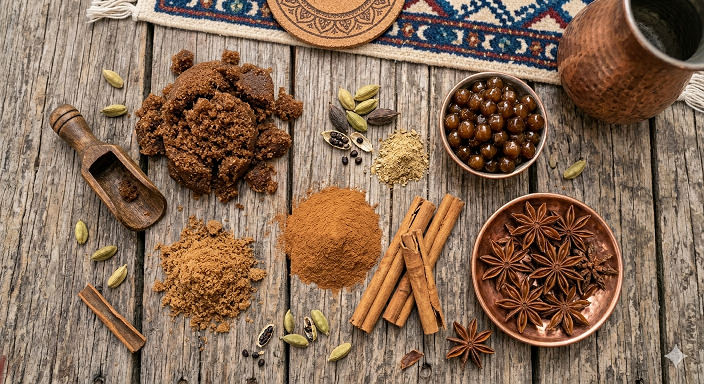
Choosing tea that stands up to milk and ice
A robust plain black tea is a practical starting point. Assam or a breakfast blend can work, but leaf size and brewing instructions matter as much as the name. Very fine tea can become strong quickly, while larger leaves may need a little longer.
The recipe uses more tea relative to water than an ordinary drinking cup because you will add twice as much milk as tea, plus ice. Increasing the amount of tea is generally a more controllable way to build flavor than repeatedly extending the steep until the brew becomes bitter.
Two pre-spiced chai tea bags can replace the plain tea and crushed cardamom. Brew them in the measured water according to their instructions, then strain or remove the bags and measure the finished tea. Because their spice strength varies, you may want less cardamom or cinnamon in the syrup.
A finished cup of milky masala chai is not equivalent to this milk-free tea base. Using it and adding a full cup of milk again changes the balance. Choose the from-scratch method above or the concentrate shortcut below rather than mixing their measurements.
Using store-bought chai concentrate
Commercial concentrates have different dilution instructions. Some use equal parts concentrate and milk; others are much stronger. Follow the product’s ratio instead of automatically adding 120 ml concentrate to 240 ml milk.
For example, if your concentrate specifies equal parts, use 180 ml concentrate and 180 ml milk for approximately the same 360 ml liquid base before syrup and ice. This is a dilution example, not the recipe for every concentrate.
Taste the concentrate-and-milk mixture before adding brown sugar syrup. A sweetened concentrate may need only a small amount or none. For ingredient and dilution comparisons, see our guide to chai concentrates for hot and iced lattes.
Check whether the package is a concentrate, a ready-to-drink beverage or a powder. These are not interchangeable by volume. Also follow its refrigeration instructions after opening, even if it was stored on a shop shelf before purchase.
Which milk works best?
Whole milk makes a creamy drink, while a lower-fat milk gives a lighter texture. Unsweetened oat or soy drink can work in the same amount as the milk in the from-scratch recipe. Almond and coconut drinks contribute more of their own flavor, depending on the product.
Read the label: a sweetened or vanilla-flavored milk alternative can change how much syrup you need. Shake the carton if its instructions recommend it, because some products separate during storage.
Barista-style products can be useful for foam, but this iced latte does not require steamed milk. There is no need to buy a more expensive carton simply because the drink is called a latte. A milk you enjoy cold is a sensible first choice.
How to get layers without sacrificing flavor
For a photograph, you can put cooled syrup into the glass, add ice, then slowly pour in the chilled tea and milk. Pouring gently over the back of a spoon may soften the mixing, but distinct layers are not guaranteed. Temperature, pouring speed, syrup thickness and ice placement all affect the appearance.
For drinking, stir thoroughly. A neat stripe of syrup at the bottom can otherwise leave the first sip bland and the last sip overly sweet. The standard instructions mix the syrup with tea first because even flavor matters more than keeping separate colors.
If you prefer foam, froth a small portion of the measured cold milk separately and spoon it on top. It is optional and may settle quickly. Do not add an extra cup of milk merely to create a topping unless you also want a much milder drink.
Variations and substitutions
Less sweet
Use half the syrup or less, keeping the tea and milk quantities unchanged. You can also make a smaller syrup portion with 1 tablespoon sugar, ½ tablespoon water, ⅛ teaspoon cinnamon and a tiny pinch of cardamom. This preserves the recipe’s ratio.
Dairy-free
Replace the milk with a suitable plant-based drink and check any toppings or purchased concentrate for dairy ingredients. If avoiding dairy for an allergy, consider ingredient labels and cross-contact rather than relying only on the drink’s name.
Dirty iced brown sugar chai
Add a shot of espresso that has cooled before assembly. Use a larger glass or reduce the milk slightly to make room. This creates a coffee-and-tea variation and adds caffeine; it is not part of the standard recipe.
More spice
Add a tiny pinch of ground ginger to the warm syrup, or experiment with a small amount of our homemade chai spice mix. If using the mix, start with ⅛ teaspoon instead of the syrup’s cinnamon and cardamom. This is a different spice profile, not a precise equal-strength substitution.
Seasonal pumpkin variation
For a drink designed around real pumpkin puree, follow our pumpkin chai latte recipe, which includes an iced method. Adding puree changes texture as well as flavor, so it deserves its own measurements.
Troubleshooting
My iced chai tastes watery
Check that the tea was cold before assembly. Hot tea melts ice rapidly, diluting the drink before you take a sip. Use the measured milk rather than filling an oversized glass to the top, and do not leave the assembled latte standing for a long time.
The tea tastes bitter
Shorten the steep or try a less finely broken tea. Adding more syrup may mask bitterness but also changes the sweetness. Note the tea quantity and timing so you can adjust the next batch systematically.
The syrup forms a sticky lump
It may have reduced too far during heating. Loosen it with a little hot water and cool it before use. Mixing syrup into the chilled tea before adding ice is easier than trying to dissolve a thick ribbon at the bottom of a crowded glass.
There are spice specks in the drink
Ground cinnamon and cardamom do not dissolve completely. A little sediment is expected. Stir before serving and avoid increasing ground spices dramatically. A fine strainer removes larger particles but cannot guarantee a completely clear syrup.
It is creamy but does not taste enough of chai
First reduce any heavy toppings or excess syrup. For your next batch, use a more robust tea or slightly increase the leaf quantity. You can also try less milk, but record that change so it does not become an unmeasured mixture.
Make-ahead preparation and storage
For the best texture, store chilled tea, syrup and milk separately, then assemble with fresh ice. Do not prepare a pitcher with ice hours ahead and expect the same strength when it melts.
A four-portion syrup batch uses 8 tablespoons brown sugar, 4 tablespoons water, 1 teaspoon ground cinnamon and approximately four small pinches of cardamom. Divide the cooled syrup into four equal portions; each portion corresponds to the full syrup amount in the one-serving recipe. Use less per glass if preferred.
Make small batches and refrigerate them promptly in clean, covered containers. As a cautious home-preparation limit for this recipe, plan to use the tea and syrup within 3–4 days rather than assuming every homemade spiced syrup keeps for two weeks. This is not a laboratory-tested shelf life. Follow shorter ingredient-specific limits where applicable.
Keep the refrigerator at 40°F (4°C) or below. Refrigerate perishable drinks within 2 hours, or within 1 hour above 90°F (32°C), following FoodSafety.gov’s food-handling guidance. Adding ice does not make a milk drink safe to leave out indefinitely.
Label preparation dates and avoid dipping used drinking spoons into stored syrup. Discard ingredients showing mold or other spoilage, but do not rely on smell alone to decide whether a poorly stored drink is safe. The assembled latte is best made for immediate drinking.
Caffeine, sugar and coffee-shop comparisons
Black tea contains caffeine. The amount in this homemade drink depends on the tea, quantity and extraction, so there is no verified caffeine number for the recipe. Decaffeinated black tea is an option, but the FDA notes that decaffeinated tea still contains some caffeine.
The syrup contains added sugar whether it is light brown, dark brown or dissolved in extra water. Milk, sweetened concentrates and flavored plant-based drinks can contribute additional sugars. A homemade label alone does not establish that the drink is low-sugar, low-calorie or suitable for a particular diet.
For a café comparison, use the exact product, size, milk and customizations available at that location. Do not treat a standard iced chai, a customized brown sugar chai and a brown sugar espresso drink as the same beverage. Their recipes and nutrition can differ.
How to estimate the cost per serving
Add the cost of the tea, milk, sugar and spices actually used in one drink. Do not charge an entire bag of sugar to one serving, but do account for ingredients you end up discarding. If you use only half the syrup, divide the syrup cost accordingly.
Imported milk alternatives, specialty tea, delivery charges and equipment purchases can change the result. A useful comparison uses local prices and similar serving sizes, rather than a fixed claim that every homemade latte costs less than a particular amount.
Start with the equipment you already own. A spoon, strainer and ordinary large glass are sufficient; a frother, decorative straw or matching glass set is optional. Buy extras only if they solve a problem you actually encounter.
Frequently asked questions
Can I make this with regular black tea bags?
Yes. Use two standard bags with the crushed cardamom and measured brewing water. The syrup supplies cinnamon and another small amount of cardamom. Follow the tea’s instructions if they call for a different steeping time.
Can I use white sugar?
Yes, in the same amount, but the molasses flavor will be missing. The result is a cinnamon-cardamom iced chai latte rather than the same brown sugar drink.
Do I need to make syrup separately?
Not necessarily. For a less layered shortcut, dissolve the measured sugar and ground spices directly into the hot strained tea, then chill it before adding milk and ice. Use a smaller sugar amount at the start if you want less sweetness.
Can I make it without a frother?
Yes. The standard recipe only needs stirring. Foam is an optional topping and is not required for the drink’s flavor or texture.
Is this the same as brown sugar bubble tea?
No. This recipe does not include tapioca pearls and uses a spiced black tea base. Adding pearls would create another variation with its own preparation and storage requirements.
What should I serve with it?
A lightly sweet biscuit or plain toast works well. For a fuller breakfast, try our chai French toast, keeping the drink less sweet if you add syrup to the toast too.
The simplest route to a balanced glass
Brew a strong but not bitter tea, chill it properly and add the syrup gradually. Once those steps are right, you can change the milk or spice level without losing the balance. Stir before drinking and save the elaborate layers for the photograph.
2 thoughts on “Iced Brown Sugar Chai Latte: Easy Homemade Recipe”